


What an olive oil tasting set really contains
An olive oil tasting set is the most direct way to understand what distinguishes one oil from another. Three well-chosen bottles, a clear tasting sequence, and appropriate support are enough to transform an ordinary evening into a true culinary moment.
Most sets sold in delis group oils from the same region or producer. This is a commercial logic, not a tasting logic. To learn how to distinguish profiles, you need to choose contrasting oils: a green fruity oil, a ripe fruity oil, and a flavored oil. This triptych covers the essential gustatory spectrum of extra virgin olive oil.
Green fruity, ripe fruity: the fundamental difference
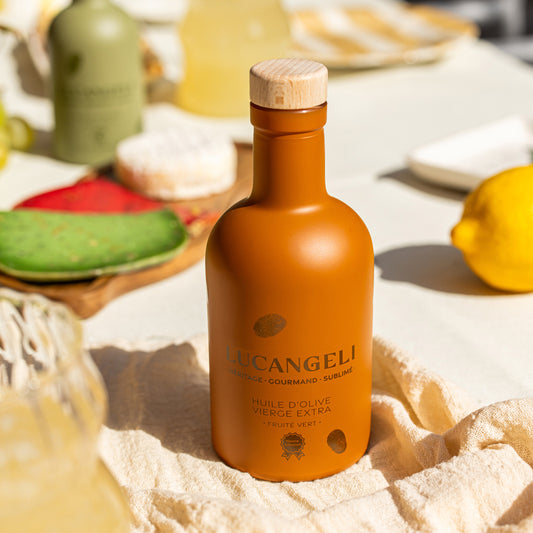
Green fruity refers to an oil extracted from olives harvested before full maturity. It has a frank attack, a marked bitterness, and a pungency at the finish. It is the oil for raw vegetables, carpaccios, and raw fish. An organic green fruity oil in 200 ml is the ideal starting point for a tasting sequence, precisely because its aromas are the most intense.
Ripe fruity, conversely, comes from olives harvested at advanced maturity. It is softer, rounder, with notes of fresh almond or yellow-fleshed fruits. Carolea, an emblematic Calabrian variety, typically yields this profile: low pungency, velvety attack, long and soft finish. An organic ripe fruity oil in 200 ml is suitable for pasta, roasted vegetables, and bread.
Flavored oil: third step in the sequence
A flavored oil completes the set by opening a third dimension. The distinction to know: an infused oil is obtained by co-milling the fruit with the olives at the time of extraction. A flavored oil is obtained by adding flavoring after extraction. The gustatory result is radically different. The bergamot olive oil, awarded the Épicures d'Argent 2023, is obtained by co-milling: the fruit is present from the crushing, which gives an aromatic integration that the addition of flavoring cannot reproduce.
How to organize the tasting sequence

The order in which you taste the oils changes everything. Starting with an intense flavored oil distorts the perception of subsequent oils. The rule is simple: from mildest to most intense, from ripe fruity to green fruity, and the flavored one last.
Temperature and support
Serve the oils at room temperature, between 18 and 22 °C. Below this, the aromas are attenuated. Above this, any defects are amplified. For the support, unsalted white bread is the most neutral. A lightly toasted slice of country bread is also suitable, provided it is not rubbed with garlic, which would mask the nuances. Pour about a teaspoon per tasting, into a small white cup if possible: the white color allows you to observe the oil's hue.
The trio of organic olive oils in 200 ml: a ready-to-use set
If you want to avoid composing the set yourself, the 200 ml trio brings together three complementary profiles in a format designed for tasting. The small sizes guarantee freshness: a 200 ml bottle is used up in two to three weeks, which prevents oxidation that alters the aromas. For two people who wish to explore the profiles over several weeks, the 500 ml discovery duo offers a good balance between volume and freshness.
What you note during the tasting
Here are the four points to observe for each oil:
- Color: from straw yellow to intense green, it gives a first indication of the olives' ripeness at harvest.
- Smell: bring your nose close to the cup and identify the dominant aromas. Fresh grass, artichoke, green tomato for a green fruity. Almond, butter, ripe fruits for a ripe fruity.
- Palate attack: the first sensation on the tongue. Soft or frank?
- Pungency: the warming sensation in the throat, a few seconds after swallowing. It is linked to the content of phenolic compounds and varies according to the variety and vintage.
Tasting set or gift set: two different logics

A tasting set is designed for exploration. It prioritizes the diversity of profiles over quantity. A gift set, on the other hand, is designed for giving. It focuses on presentation, visual coherence, and legibility for someone who may not be familiar with the subject.
Composing an olive oil gift set
To offer an olive oil set, three practical rules:
- Include at least two oils of different profiles, so that the recipient can compare.
- Add a complementary product: a balsamic vinegar, a tapenade, or a spread creates a coherent and immediately usable ensemble.
- Pay attention to the packaging: a closed box, a ribbon, a handwritten card. The customizable gift set allows you to choose the products and packaging in a single order.
When to offer a tasting set
A tasting set is a relevant gift for a housewarming, a cooking enthusiast's birthday, or an original corporate gift. For establishments that wish to offer a tasting set to their clients or teams, the professional area provides access to formats and conditions adapted to professional volumes.
The personalized bottle in a set
For a truly unique set, bottle personalization is possible from 24 units. The design is created directly on the online configurator: you choose the visual, text, and colors. This is a particularly popular option for corporate gifts or family events, where the bottle becomes a souvenir as much as a product.
Frequently asked questions
How many oils should be in a tasting set for it to be truly useful?
Three oils are enough for an instructive tasting, provided they are contrasting: one green fruity, one ripe fruity, one flavored. Beyond five oils, taste fatigue sets in and the last oils are poorly evaluated.
In what order should the oils in a tasting set be tasted?
Always start with the mildest oil, the ripe fruity, then move to the green fruity, which is more intense. Finish with the flavored oil. Between each oil, rinse your mouth with water and wait one minute before moving on to the next.
What is the difference between an olive oil tasting set and a gift set?
A tasting set is designed for comparison and learning: it prioritizes the diversity of profiles in small sizes. A gift set is designed for giving: it focuses on presentation and the coherence of the whole, sometimes with complementary products like a vinegar or tapenade.




 lucangeli.it