

Offering an olive oil menu in your dining room transforms an ordinary condiment into a gourmet experience. Here’s how to structure it, present it, and train your team to make it a true differentiator.
Why offer an olive oil menu in your dining room
The wine list is a standard in gourmet restaurants. The olive oil menu, however, remains a rarity in France, even though it has existed for several years in top Italian and Greek establishments. A restaurant in Crete, for example, offers a dedicated menu to its customers, and an establishment in Puglia lists over 240 labels. In France, the market is almost entirely untapped.
This is precisely where the opportunity lies. A well-constructed olive oil menu serves three concrete functions for your establishment:
- It distinguishes your restaurant from the competition in an unexploited editorial and commercial territory.
- It justifies the pricing of quality oil to the customer, giving them the keys to understand what they are consuming.
- It creates an additional service moment, a ritual that extends the experience and enhances the memorability of your establishment.
For restaurants that already work with a quality extra virgin olive oil, the menu is not an additional investment: it's about showcasing what already exists.
How to structure an olive oil menu

Choosing which oils to feature
An oil menu doesn't need to be exhaustive to be effective. Three to five references are enough to cover the essential taste profiles and offer a real choice to the customer. The goal is to provide a logical progression, from mildest to most intense, similar to a wine selection.
Here are the four profiles to prioritize:
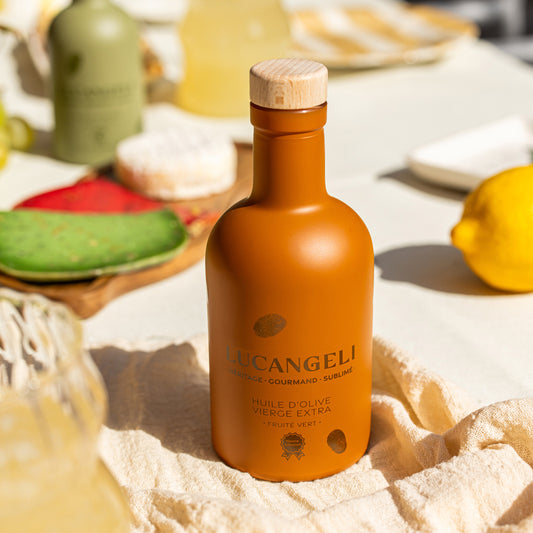
- Green fruity (Coratina, Calabria): herbaceous, artichoke, distinct pungency at the finish. Recommended use: raw fish, carpaccio, grilled vegetables.
- Ripe fruity (Carolea, Calabria): mild, fresh almond, slight bitterness. Recommended use: white meats, cheeses, bread.
- Bergamot-flavored oil, obtained by co-crushing: fresh citrus, floral, mild finish. Recommended use: desserts, fish, fresh cheeses.
- Cooking oil (blend, large format): neutral, heat-stable. Recommended use: cooking, sautéing, marinades.
Coratina deserves special attention in your selection. It is a Calabrian variety harvested in October-November, with new oil available as early as December. It stands out for its frank pungency at the finish, a sensation that surprises unsuspecting customers and, when well explained by the front-of-house team, becomes a memorable selling point rather than a perceived flaw. A green fruity olive oil from this early harvest perfectly illustrates this profile.
Presenting the oils: essential information
Each reference on your menu should include at least:
- The commercial name or designation of the oil.
- Geographical origin (region, PDO or PGI appellation if applicable).
- Olive variety or blend.
- Taste profile in two or three words (fruity, bitter, pungent, mild, herbaceous).
- One or two recommended pairings with dishes on your menu.
- Price per glass or tasting, if offered.
Avoid overly technical descriptions or laboratory terms. The customer is not a tasting panel: they want to understand what they will experience and how the oil will complement their dish.
The menu format
Several formats are possible depending on your establishment's positioning:
- A separate printed menu, on thick or card stock, presented with the wine list. This is the most prestigious format, clearly signaling that olive oil is treated as a product in its own right.
- An insert in the main menu, as a dedicated section. More discreet, but sufficient for an initial rollout.
- An oral presentation by the server, without written support. Effective in smaller establishments, provided the team is trained and comfortable with the presentation.
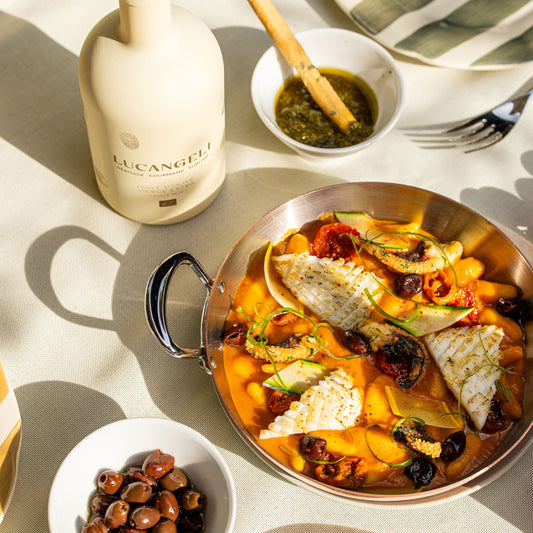
For establishments wishing to go further, a customized bottle with the establishment's branding placed on the table reinforces consistency between the menu and the service. The minimum order is 24 bottles, with a design created by the establishment using a configurator.
Training the front-of-house team for olive oil service
What every server should know
The oil menu is only valuable if the front-of-house team can promote it. A server who cannot explain the difference between a green fruity and a ripe fruity oil cannot sell the experience: they can only place the bottle on the table.
Training doesn't need to be long. A two-hour session is enough to cover the essentials:
- The difference between extra virgin, virgin, and lampante oil, and why only extra virgin deserves to be served in the dining room.
- The three basic taste profiles: green fruity (herbaceous, pungent), ripe fruity (mild, round), flavored (infused or co-crushed).
- Fundamental pairings: raw fish with a green fruity, meats and cheeses with a ripe fruity, desserts and fresh cheeses with a bergamot oil awarded at the Épicures d'Argent 2023.
- Customer discourse: a maximum of two sentences to present the oil, without technical jargon.
A frequently overlooked point: the pungency of Coratina. This warming sensation in the throat, characteristic of intense green fruity oils, is often interpreted as a defect by customers unfamiliar with it. Training the team to anticipate it, by saying something like "you'll feel a slight warmth at the finish, that's a sign of an early harvest oil, it's intentional," transforms a potentially unpleasant surprise into a memorable signature.
The service ritual
Olive oil service in the dining room follows a logic similar to wine. Here is the recommended protocol:
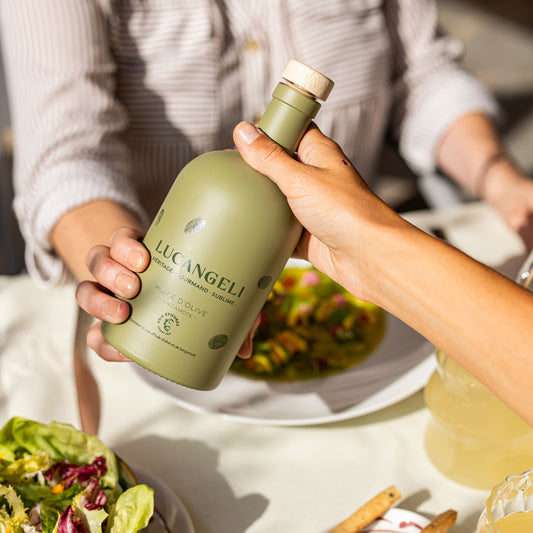
- Present the unopened bottle to the customer, as you would a bottle of wine, naming the oil and its origin.
- Pour a small amount into a small bowl or directly onto the plate, depending on the context.
- Suggest a pairing with the current or upcoming dish.
- Leave the bottle on the table if the customer wishes, or return it to the kitchen to prevent oxidation.
This last point is important: an open bottle left too long on the table, exposed to light and heat, will degrade. For establishments with high cover volumes, the 5-liter jerry can is the solution for cooking and preparations, while 200 ml small formats or the limited edition Jeroboam are reserved for dining room service and presentation.
Frequently asked questions
How many olive oils should be offered on a restaurant menu?
Three to five references cover the essential profiles without overloading the menu. Ideally, offer at least one green fruity, one ripe fruity, and one flavored oil, to provide a coherent taste progression with the dishes served.
How to quickly train the front-of-house team for olive oil service?
A two-hour session is enough to cover the basics: the three taste profiles, fundamental pairings, and a two-sentence customer pitch. The essential thing is for each server to be able to explain the difference between the oils offered and to anticipate customer reactions, especially to the pungency of an intense green fruity oil.
Can an olive oil menu be offered in a non-gourmet restaurant?
Yes. The oil menu is not reserved for Michelin-starred restaurants. A bistro, trattoria, or seaside restaurant can offer two or three references with a simple presentation. What matters is the coherence between the oil's quality, the team's presentation, and the establishment's positioning.






 lucangeli.it