


Which olive oil should you choose depending on its use? The answer lies in a simple rule: a green fruity oil for dishes that need character, a ripe fruity oil for cooking and gentle preparations, and a flavored oil for finishing. Here's how to choose without making a mistake.
Most buying guides only distinguish between extra virgin and virgin. This is helpful, but insufficient. What really changes the result on the plate is the aromatic profile of the oil: green fruity or ripe fruity. And for finishing, flavored oils open up a third category that many are still unaware of.
Green fruity or ripe fruity: what's the concrete difference?
The aromatic profile of an olive oil depends on the ripeness stage of the olives at the time of harvest. It's not a question of superior or inferior quality: it's a question of style, exactly as one distinguishes a dry white wine from a sweet white wine.
Green fruity: intensity and character
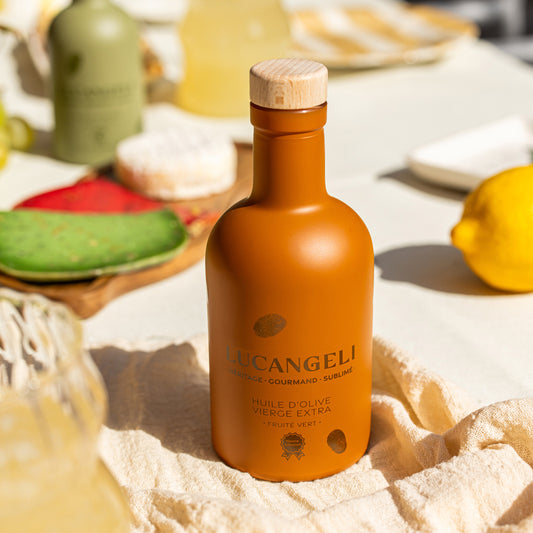
A green fruity olive oil is obtained from olives harvested early in the season, before full ripeness. It is recognized by its frank attack, its notes of fresh grass, raw artichoke or green tomato, and its pungency at the end of the mouth. This slight pungent sensation signifies a quality oil.
The Coratina variety, originally from Puglia, is one of the benchmarks for intense green fruity oil. It produces oils with a marked bitterness and pronounced pungency, highly appreciated by connoisseurs and chefs looking to structure a dish.
Ideal uses for green fruity oil:
- Drizzled over burrata or mozzarella di bufala
- Seasoning a tomato salad or raw vegetables
- Finishing a beef or fish carpaccio
- Toasted bread rubbed with garlic (bruschetta)
- Vegetable soup or minestrone, added off the heat
Ripe fruity: sweetness and versatility
A ripe fruity olive oil is produced from olives harvested at full ripeness. It presents rounder notes: almond, fresh butter, cooked artichoke, sometimes a slight touch of dried fruit. The pungency is discreet, the bitterness almost absent.
The Carolea variety, cultivated in Calabria for centuries, is emblematic of this profile. It produces soft, balanced oils that integrate without dominating. It is the main variety of the house's oils: hand-harvested in the Calabrian olive groves, it is crushed within 24 hours of picking to preserve all its freshness.
Ideal uses for ripe fruity oil:
- Pan-frying (vegetables, fish, white meats)
- Oven cooking up to 180 degrees Celsius
- Pasta, risotto, stewed dishes
- Pastry (olive oil cake, savory cake)
- Gentle vinaigrette or homemade mayonnaise
Comparative guide: which oil for which use
Here are the most common uses with the recommended type of oil, the time of addition, and the reference variety.
- Tomato salad or raw vegetables: green fruity, cold when serving, Coratina variety.
- Bruschetta and toasted bread: green fruity, cold after baking the bread, Coratina or Frantoio variety.
- Beef or fish carpaccio: green fruity, as a cold finish, Coratina variety.
- Soup and minestrone: green fruity, off the heat as a finish, Carolea or Coratina variety.
- Pan-frying: ripe fruity, at the beginning of cooking, Carolea variety.
- Oven cooking: ripe fruity, at the beginning of cooking, Carolea variety.
- Pasta and risotto: ripe fruity, at the end of cooking or for mantecatura, Carolea variety.
- Pastry: ripe fruity, in the dough, Carolea variety.
- Gentle vinaigrette: ripe fruity, cold, Carolea variety.
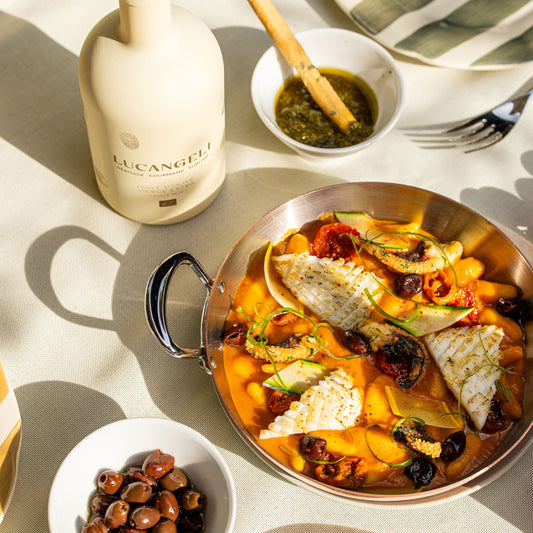
- Grilled fish for finishing: green fruity or lemon flavored, off the heat, Coratina variety or lemon oil.
- Pizza and focaccia: ripe fruity, before and after cooking, Carolea variety.
- Roasted vegetables: ripe fruity, before cooking, Carolea variety.
For daily use, the discovery duo in two 500 ml bottles allows you to test both profiles side by side before choosing the one that best suits your cooking.
Flavored oils: when and how to use them

Flavored oils constitute a third category, often underestimated. They do not replace a quality extra virgin oil: they complement it, for precise finishes or sought-after pairings.
Bergamot, basil, garlic-chili: three distinct profiles
There are two ways to produce a flavored oil. The first, and most qualitative, is co-milling: the fruit or herb is ground at the same time as the olives during crushing. The aromas integrate naturally into the oil. The second is flavoring by addition: a natural or artificial aroma is incorporated after extraction. The result is less refined, less stable, and often less precise on the palate.
The bergamot olive oil, awarded the Épicure d'Argent 2023, is obtained by co-milling Calabrian olives and fresh Calabrian bergamots. Its profile is floral and slightly acidic, ideal with white fish, a citrus salad or a dessert made with fresh cheese.
The organic basil olive oil is used as a finishing touch on pasta, Margherita pizza, or Caprese salad. It provides the freshness of basil without having to chop leaves.
The organic garlic and chili olive oil is the most versatile of the three for everyday cooking: a few drops on roasted vegetables, aglio e olio pasta, or grilled meat are enough to transform a simple dish.
Building your home oil cellar
The idea of an oil cellar is based on a simple principle: having two or three open bottles at the same time, each with a specific role.
A basic oil cellar includes:
- A green fruity oil for cold seasonings and finishes
- A ripe fruity oil for cooking and gentle preparations
- A flavored oil for creative finishes
To get started without hesitation, the trio of olive oil in three 200 ml bottles is designed exactly for this: three different profiles, three small formats that are consumed before oxidation.
Some practical rules for managing your cellar:
- An open bottle should ideally be consumed within four to six weeks.
- Store it away from light, heat, and air, with the cap closed.
- Avoid clear bottles exposed to the window.
- If you consume a lot of oil daily, the 5-liter jerry can is more economical and reduces packaging.
- For special occasions or gifts, the limited edition jeroboam is a spectacular format that keeps well thanks to its volume.
If you're looking to offer an introduction to the world of olive oils, the customizable gift box allows you to select bottles according to the recipient's tastes.
For establishments wishing to offer several oil profiles to their customers, the professional area details the available formats and supply conditions.
Frequently Asked Questions
What is the difference between a green fruity and a ripe fruity olive oil?
Green fruity is produced from olives harvested early, before full ripeness. It yields intense oils with notes of fresh grass, raw artichoke, and a pungency at the finish. Ripe fruity is obtained from olives harvested at full ripeness: the oil is softer, with notes of almond and fresh butter. Green fruity is used cold, while ripe fruity is suitable for both cooking and seasoning.
Can extra virgin olive oil be used for oven cooking?
Yes, extra virgin olive oil can withstand temperatures up to 180-190 degrees Celsius, which covers the vast majority of oven cooking. For this type of use, prefer a ripe fruity profile, whose mild aromas integrate better with heat. Green fruity, being more intense, is better utilized cold or as a finishing touch off the heat.
How long does an open bottle of olive oil keep?
An open bottle should ideally be consumed within four to six weeks under good conditions: away from light, heat, and air. Beyond that, the oil does not become dangerous, but it gradually loses its aromas and can develop a rancid taste. To avoid this waste, adapt the bottle size to your actual consumption: a 200 ml size for occasional use, 500 ml for regular use, 1 liter or more if you cook with olive oil every day.





 lucangeli.it