

The free acidity of extra virgin olive oil is a maximum of 0.8%. You may have seen this figure on a label, but do you really know what it measures? Contrary to popular belief, this level has nothing to do with any sour taste you might perceive. It is a chemical indicator, undetectable to the palate, which provides information about the condition of the olive at harvest and the speed of processing after picking.
What free acidity really measures
A chemical reaction, not a sensation
Free acidity expresses the quantity of free fatty acids present in the oil, measured in grams of oleic acid per 100 grams of oil. It is not detectable during tasting: even an oil with 0.8% acidity can have a mild, fruity taste, while an oil with 0.1% can be very bitter and pungent. The bitterness and pungency you feel in your mouth are due to polyphenols, not free acidity. These are two completely distinct parameters.
To measure free acidity, a certified laboratory and specific chemical analysis are required. No taster, no matter how experienced, can estimate this level blindly. This is why the mentions "0.2%", "0.4%", or "0.8%" on labels are analytical data, not taste descriptors.
Where and when acidity forms
Here's what most articles on the subject don't mention: acidity doesn't form during trituration. It forms in the olive itself, even before the fruit reaches the mill. When an olive is mechanically damaged by an impact, a fall, or an olive fly attack, or when it remains on the tree for too long after ripening, natural enzymes (lipases) begin to break down triglycerides and release fatty acids. The longer the delay between picking and trituration, the more this phenomenon intensifies.
This is why serious producers process their olives within 24 to 48 hours of harvest. It is also why hand-picking, which preserves the fruit's integrity, is a determining factor in obtaining low acidity. A discovery duo of 500ml olive oil bottles allows you to compare two oil profiles resulting from this same harvesting requirement.
Regulatory thresholds and what they mean

Official categories and their thresholds
European regulations set free acidity thresholds for each category of olive oil. Here are the values to remember:
- Extra virgin olive oil: maximum free acidity of 0.8%
- Virgin olive oil: maximum free acidity of 2.0%
- Lampante olive oil (not edible raw): acidity greater than 2.0%
- Olive oil (refined + virgin): maximum free acidity of 1.0%
- Olive pomace oil: maximum free acidity of 1.0%
The "extra virgin" category is therefore the only one to guarantee an acidity equal to or less than 0.8%. But this threshold is a legal maximum, not a target. The best artisanal oils are well below this, often between 0.1% and 0.3%.
Calabrian appellations go further
The protected designations of origin in Calabria impose even stricter criteria than general regulations. The Bruzio PDO and Lametia PDO appellations require free acidity below 0.5%, and the Olio di Calabria PGI also sets thresholds below the European legal maximum. These additional requirements are not insignificant: they guarantee that certified oils come from olives harvested in good conditions and processed quickly.
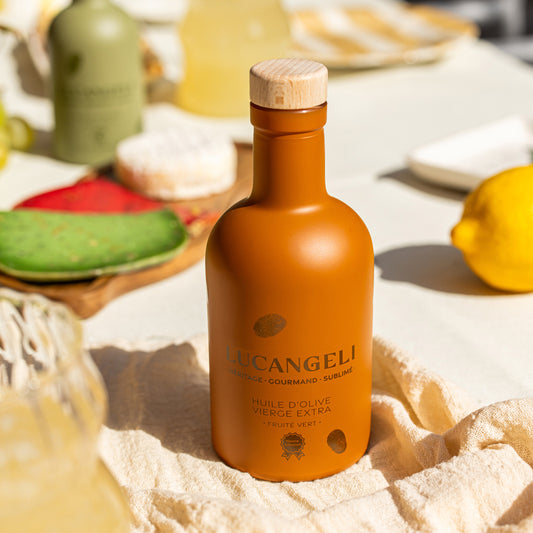
To explore a green fruity organic olive oil from this Calabrian tradition, acidity is one of the first parameters controlled at each harvest.
The Carolea variety, a natural asset
Carolea is one of Calabria's emblematic olive varieties. Hand-picked before full ripeness, it naturally has very low acidity, often below 0.3%, making it one of the varieties best suited to the requirements of the Calabrian PDO appellations. Its aromatic profile is characterized by an intense green fruitiness, with notes of fresh grass and artichoke, and a frank pungency at the end of the mouth. It is not acidity that creates this sensation: it is the richness in phenolic compounds specific to the variety and the harvest stage.
How to read the label and choose knowingly
What the label tells you (and what it doesn't)
When you see "acidity: 0.2%" on a bottle, you know that the oil was produced from healthy olives, harvested and processed quickly. This is a good sign. But acidity alone is not enough to judge the overall quality of an oil. Other parameters come into play: the peroxide value (which measures primary oxidation), the K232 and K270 spectrophotometric coefficients, and of course the organoleptic panel test, which evaluates aromas and the absence of defects.
An oil can show an acidity of 0.2% and still be oxidized if it has been poorly stored or exposed to light. This is why a dark bottle, storage away from heat, and the harvest date (not just the best-before date) are equally important indicators. A ripe fruity organic olive oil in a 200ml bottle carries this information on its label.
Low acidity doesn't mean mild oil
This is the most widespread misconception. An acidity of 0.1% does not imply a neutral or light oil. Some very low acidity oils are among the most intense and pungent on the market, precisely because they are produced from early-harvested olives, rich in phenolic compounds. Aromatic intensity and pungency are sought-after qualities, not defects. They indicate an early harvest and careful processing.
If you want to discover several oil profiles to understand these differences in practice, the organic olive oil trio in 200ml is a good starting point. Restaurateurs and professionals who wish to delve deeper into the subject for their menu or supply can consult the dedicated professional section.
Frequently asked questions

Can the free acidity of olive oil be tasted?
No. Free acidity is a chemical parameter that cannot be perceived by taste. It can only be measured in a laboratory. What you feel as "pungent" or "bitter" in an olive oil is due to polyphenols, not free acidity.
What is the difference between an oil with 0.2% and an oil with 0.8% acidity?
Both are extra virgin olive oils, legally compliant. The difference lies in the production conditions: an oil with 0.2% typically comes from hand-picked, healthy olives processed quickly. An oil with 0.8% remains within standards, but the harvesting or storage conditions of the olives may have been less stringent.
Can free acidity be found on all olive oil labels?
No. Displaying free acidity on the label is not mandatory in Europe. When it is mentioned, it is often a sign that the producer emphasizes transparency and quality. However, if it is displayed, other analytical parameters (peroxide value, K232, K270) must also appear on the label, in accordance with European regulations.



 lucangeli.it