


Why olive oil changes everything in grilled eggplant
For truly flavorful grilled eggplant with olive oil, everything comes down to two decisions: which oil you use and when you add it. A green fruity oil, poured in two stages, transforms a simple vegetable into a dish with character.
Eggplant is a porous vegetable. It absorbs oil quickly, which can become a pitfall if you use a neutral or poor-quality oil: the result is greasy without being flavorful. Conversely, a quality extra virgin oil, chosen for its aromatic profile, permeates the flesh and gives it a depth that nothing else can provide.
The Carolea variety and its aromatic profile
In Calabria, the most cultivated olive variety for distinctive oils is Carolea. It produces a green fruity oil with notes of fresh grass, artichoke, and green tomato, with a pronounced pungency at the finish. It is precisely this pungency that pairs with the smoky flesh of grilled eggplant: it extends the cooking aromas instead of overpowering them.
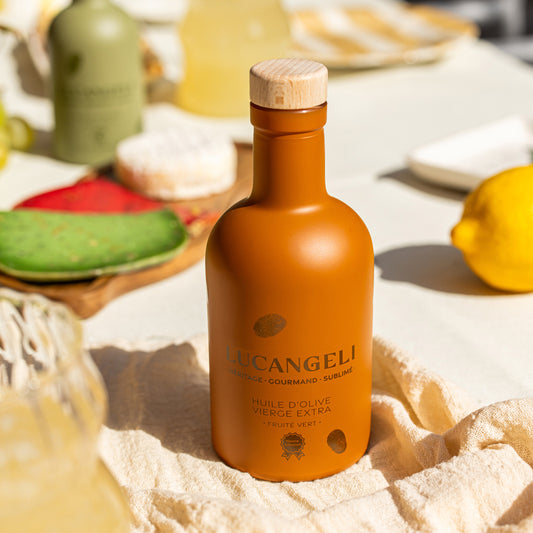
A green fruity organic oil from the Carolea variety is therefore the reference choice for this recipe. If you prefer a milder profile, a ripe fruity oil will also work, with notes of ripe tomato and almond that soften the whole.
The two-stage rule
The Calabrian technique relies on a two-stage application. Before cooking, brush each slice of eggplant with 3 to 4 tablespoons of oil in total for 4 people. The oil penetrates the flesh and protects the surface from drying out. After cooking, drizzle a finishing touch of 1 to 2 tablespoons over the still-warm eggplant, off the heat. It is at this moment that the oil's aromas fully express themselves, without being degraded by the heat.
Never pour all the oil before cooking: heat destroys some of the aromatic compounds. The raw finish is what makes the difference between an ordinary grilled eggplant and a Calabrian melanzana grigliata.
The complete recipe: melanzane grigliate alla calabrese

Ingredients for 4 people
To make this recipe, you need: 2 large firm eggplants (about 700g), preferably a long variety; 5 to 6 tablespoons of green fruity extra virgin olive oil; 2 cloves of garlic; 8 to 10 fresh basil leaves; 4 to 5 fresh mint leaves; fine salt to taste; and a small pinch of Calabrian chili pepper (optional).
Step-by-step preparation
- Wash the eggplants and cut them into 1 cm thick slices lengthwise. Slices that are too thin burn before cooking, while slices that are too thick remain raw in the center.
- Arrange the slices on a rack or board and sprinkle lightly with fine salt. Let them drain for 20 minutes, then pat dry with paper towels. This step reduces bitterness and limits oil absorption during cooking.
- Brush each slice with 3 to 4 tablespoons of extra virgin oil in total, using a brush or your hands.
- Heat a grill pan or cast iron grill over high heat. Place the slices without overlapping them. Cook for 3 to 4 minutes on each side until distinct grill marks appear and the flesh is tender.
- Arrange the slices on a plate. Immediately rub each slice with half a clove of garlic, cut in two.
- Drizzle with the finishing oil: 1 to 2 tablespoons of green fruity oil over the entire dish, while still warm.
- Sprinkle with fresh basil and mint leaves. Add a pinch of Calabrian chili pepper if you like spice.
Variations and accompaniments
For a more intense version, replace the finishing oil with garlic and chili olive oil: the aromas are already infused into the oil, resulting in a more homogeneous flavor than adding raw garlic.
For a complete antipasto, serve the grilled eggplants with black olive tapenade and a few slices of toasted bread. This is how they are served in Calabrian trattorias in the summer.
Storage and usage tips

Grilled eggplants keep very well in the refrigerator, covered with olive oil, for 3 to 4 days. They even improve with time: the aromas of the oil and herbs infuse into the flesh.
To preserve them longer, layer the slices in a sterilized jar, alternating with garlic, basil, and mint, and cover completely with oil. Seal tightly and store in the refrigerator. Consume within 10 days.
Uses in cooking
Grilled eggplants with olive oil are not limited to antipasto. Here are five ways to use them:
- As a bruschetta topping, with a slice of toasted bread and a few basil leaves.
- In a sandwich or focaccia, with mozzarella and tomatoes.
- As a side dish for grilled meat or baked fish.
- Roughly chopped and mixed with pasta with a drizzle of finishing oil.
- As a base for a warm salad with cherry tomatoes and balsamic vinegar.
If you cook regularly with olive oil, the discovery trio allows you to test all three profiles to adapt the oil to each preparation.
For professional kitchens looking to integrate this type of preparation into their menu, the professional section offers formats adapted to restaurant volumes.
Frequently asked questions
What olive oil to use for grilling eggplant? An extra virgin green fruity oil, from varieties like Carolea in Calabria, is ideal. Its pungency and notes of fresh grass pair well with the smoky flesh of eggplant. Use it in two stages: 3 to 4 tablespoons before cooking, then 1 to 2 tablespoons as a finish after cooking.
Should eggplants be drained before grilling? Yes, 20 minutes of salting reduces bitterness and limits oil absorption during cooking. Pat the slices well with paper towels before brushing them with oil.
How to store grilled eggplants in olive oil? Arrange the slices in a sterilized jar, cover completely with extra virgin olive oil, seal tightly, and store in the refrigerator. Consume within 10 days. The flavors develop over time.



 lucangeli.it