

Pistachio paste has become an essential ingredient in the kitchens of pastry chefs and amateur cooks in recent years. But with the multitude of products available — 100% paste, sweetened paste, flavored preparations — it's not always easy to know what to choose. How do you choose the right pistachio paste? How do you use it in sweet and savory cooking? This guide covers everything you need to know.
Pistachio puree or pistachio paste: what's the difference?

These two terms are often used interchangeably, but they refer to distinct products. Understanding this difference is the first step to making the right choice for your intended use.
100% pistachio paste: pure pistachio, no additives
100% pistachio paste is obtained by grinding roasted pistachios, without adding sugar, vegetable oil, or flavorings. The result is a dense paste with a strong and intense flavor, concentrating all the natural taste of the nut. This is the product of choice for professionals and demanding amateurs who want to control the amount of sugar and the composition of their preparations.
Its texture can vary depending on the fat content of the pistachios used: more or less fluid, it is easy to work with at room temperature. A quality 100% paste should have a deep green color and a powerful aroma, indicating that the pistachios have been carefully selected.
Sweetened pistachio paste: for mainstream pastry
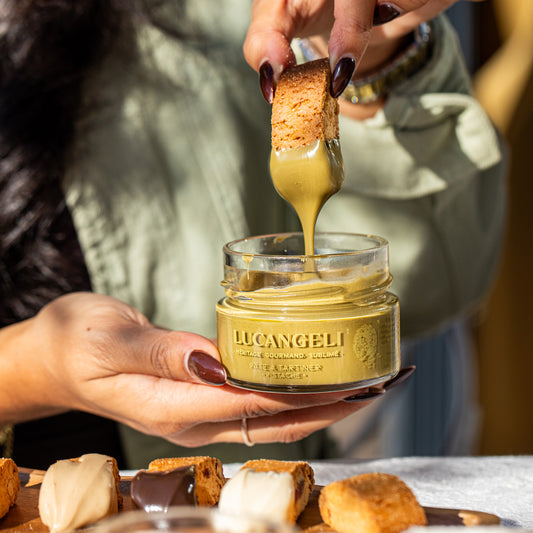
Sweetened pistachio paste, on the other hand, contains sugar and sometimes other ingredients such as vegetable oil or flavorings. It is ready to use for filling macarons, tarts, or ice creams, but offers less freedom in the composition of recipes. For those who want a version with an already balanced taste, pistachio spread — without palm oil — is a gourmet and practical alternative, ideal for brunch or a snack.
How to read labels to choose well
Before buying pistachio paste, take the time to read the list of ingredients. A 100% paste should contain only one ingredient: pistachios. If you see palm oil, artificial flavors, or colorings, it is a lower quality product. Also, prioritize products where the origin of the pistachios is clearly indicated: traceability is a guarantee of the producer's reliability.
How to use pistachio paste in cooking

Pistachio paste is a versatile ingredient that can be used in both sweet and savory preparations. Here are the main ways to use it.
In pastry and desserts
This is the most common use. 100% pistachio paste can be directly incorporated into a pastry cream, ganache, mousse, or ice cream to give them an intense and natural flavor. It is also used in financiers, madeleines, or moist cakes. For best results, it is advisable to mix it at room temperature with other fatty ingredients (butter, cream) before incorporating it into the preparation.
For those who want a ready-to-spread version, the set of 5 spreads allows you to discover several flavors — pistachio, hazelnut, almond, cocoa — and vary the pleasures according to your desires.
In savory cooking
Less known but equally interesting, pistachio paste also finds its place in savory preparations. It can be incorporated into a sauce to accompany fresh pasta, mixed with fresh cheese to stuff grilled vegetables, or used as the base for an original vinaigrette. A drizzle of organic green fruity olive oil combined with a spoonful of pistachio paste makes a light and flavorful sauce, ideal for a summer salad or steamed vegetables.
Pistachio pairs particularly well with white fish, poultry, and seasonal vegetables like zucchini or eggplant. It brings a sweet and slightly toasted note that balances the flavors.
For catering professionals
Professional chefs and pastry chefs use 100% pistachio paste for its consistency and flavor concentration. Available in 1 kg format, it meets the needs of professional kitchens that work with large quantities. 100% pistachio paste allows precise control over the sugar content and texture of preparations, which is essential in precision pastry.
For restaurateurs, hoteliers, and delicatessens who wish to supply quality nut pastes, the professional area allows them to discover the entire offer and contact the sales team.
Which pistachio paste to choose?
Today, the market offers many pistachio pastes, with significant differences in quality. Here are the criteria to consider when making the right choice.
The origin of pistachios: an essential criterion
The quality of a pistachio paste depends above all on the quality of the pistachios used. Sicilian pistachios (Bronte variety) are renowned for their intense aroma and characteristic green color. Iranian and Turkish pistachios are also highly valued for their fat content and pronounced taste. The origin must be clearly stated on the packaging: it is an indicator of transparency and quality.
A quality pistachio paste is recognized by its color (natural green, without coloring), its aroma (powerful, slightly roasted), and its texture (homogeneous, without lumps). Avoid products that are too light or too fluid, which may indicate dilution or a low pistachio content.
Nut pastes: hazelnut and almond
If you want to explore other nut pastes, 100% Piedmont hazelnut paste and 100% almond paste offer complementary aromatic profiles. Piedmont hazelnut, recognized for its exceptional quality, yields a paste with a round and slightly caramelized taste, ideal for ganaches and spreads. Almond, softer and more neutral, is easily incorporated into preparations where a subtle flavor is desired.
For those who want to discover these flavors in ready-to-spread form, hazelnut spread and almond spread are two gourmet and palm oil-free options, to be enjoyed for breakfast or a snack.



 lucangeli.it