


Where do pistachios come from? History and origins
Pistachio is one of the oldest nuts cultivated by humans. The first traces of its consumption date back more than 9,000 years, in the arid regions of the Middle East. The domestication of the pistachio tree developed in ancient Persia, where this fruit was considered a luxury product reserved for royal courts. The Romans then introduced it to Italy in the 1st century AD, and thus the pistachio began to take root in the Mediterranean basin.

Pistachios in Italy: an exceptional terroir
Italy holds a special place in the history of the pistachio. The region of Bronte, on the volcanic slopes of Etna in Sicily, has become one of the most renowned production areas in the world. The volcanic soil, rich in minerals, gives Bronte pistachios an intense emerald green color and a concentrated, slightly sweet, and deeply aromatic flavor. This variety benefits from a PDO (Protected Designation of Origin) label, guaranteeing its origin and traditional production method.
The harvest in Bronte is still largely manual and only takes place every other year — the pistachio tree naturally alternates between a year of high production and a year of rest. This rarity contributes to the value of Bronte pistachios, highly sought after by artisans and gastronomy professionals.
Other major origins of pistachios
Beyond Italy, several regions of the world produce quality pistachios. Iran, and more precisely the Kerman region, remains the world's leading producer. Iranian pistachios are renowned for their generous size, their shells that open naturally when ripe, and their rich and complex flavor. Turkey, particularly the Gaziantep (Antep) region, produces smaller but very fragrant pistachios, widely used in oriental pastries. The United States, via California, has become the second-largest producer in the world thanks to modern and standardized agriculture, offering pistachios with uniform size and a mild flavor.
How to choose and store pistachios
Criteria for a quality pistachio
Choosing a quality pistachio depends on a few simple criteria. Color is the first indicator: a quality pistachio has a pronounced green hue, a sign of ripeness and freshness. The more intense the color, the higher the quality of the pistachio — this is particularly true for use in pastry. The shell should be naturally split open, which indicates that the fruit has reached full maturity. Beware of pistachios whose shells have been mechanically opened before maturity.
For shelled pistachios, check that they are firm, dry, and free of stains. Avoid soft pistachios or those with a rancid smell — a sign of being stored for too long or in poor conditions.
How to store pistachios
Pistachios are sensitive to humidity and heat. To preserve their aromas, store them in an airtight container, away from light and heat. At room temperature, they will keep for about 3 months. In the refrigerator, they maintain their freshness for up to 6 months. For longer storage, the freezer is an effective option: place the pistachios in an airtight bag and they will keep for up to a year without losing their taste qualities.
Pistachio-based preparations — such as 100% pistachio puree — must also be stored away from light, preferably in the refrigerator after opening.
How to use pistachios in cooking and baking
Pistachio is a highly versatile ingredient. It integrates well into both sweet and savory preparations and comes in many forms: whole, crushed, powdered, as a paste, or as a puree.

Pistachios in pastries and for breakfast
In pastry, pistachio is a choice ingredient. Ground into powder, it flavors biscuits, financiers, tarts, and creams. Whole or crushed, it adds crunch to cakes, ice creams, and yogurts. Pistachio paste is widely used by professional pastry chefs to fill macarons, éclairs, or entremets.
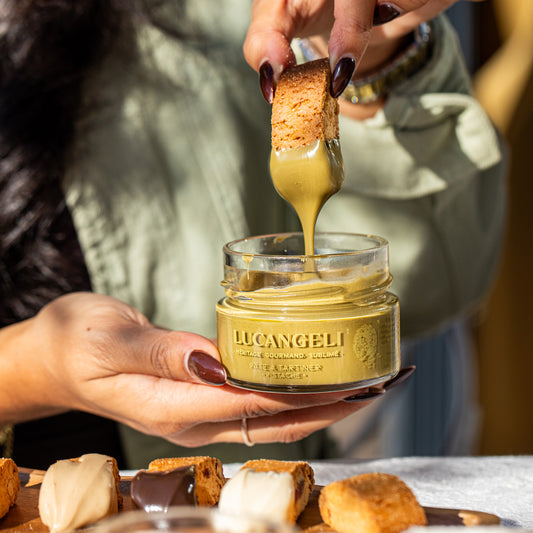
For daily use, pistachio spread is a gourmet and natural alternative to industrial spreads. Made without palm oil, it reveals the full flavor of the nut. To vary the pleasures at breakfast or snack time, the set of 5 spreads allows you to discover different expressions of nuts: pistachio, Piedmont hazelnut, almond, cocoa-hazelnut. The hazelnut spread and the almond spread ideally complete this selection for a generous sweet table.
Pistachios in savory dishes
Pistachio integrates very well into savory cuisine. Crushed, it adds crunch to summer salads, vegetable carpaccios, or fresh cheeses. It is used in the composition of many stuffings for meats (chicken, lamb, pork) and as a crust for fish or meat fillets.
In Sicilian cuisine, Bronte pistachios are used in pasta sauces — the famous pesto alla Bronte — or as a topping for pizzas and focaccias. For an Italian version of pesto, the PDO basil pesto with olive oil is an ideal base to which crushed pistachios can be added for an original touch. A drizzle of organic fruity green olive oil as a finish enhances the whole with freshness and character.
Pistachio puree: an accessible professional ingredient
The 100% pistachio puree is the reference ingredient for pastry chefs and cooks who want to work with pistachios in their purest form. Obtained by grinding roasted pistachios, without added sugar or oil, it offers maximum aromatic concentration. It is used to flavor creams, ganaches, ice creams, mousses, or sauces. To offer a gourmet selection of nuts, the customizable gift box allows you to combine purees, spreads, and other treasures from the Italian terroir according to your desires.
FAQ
What is the difference between Bronte DOP pistachios and other pistachios?
Bronte DOP pistachios are grown on the volcanic slopes of Etna in Sicily. Their unique terroir gives them an intense green color and a more concentrated flavor than other varieties. The DOP certification guarantees their origin and traditional production method. They are harvested manually, every other year, making them a rare and highly sought-after product.
How to recognize a quality pistachio?
A quality pistachio has a pronounced green color, a naturally split shell, and a firm texture. Avoid soft, stained, or rancid-smelling pistachios.
Can pistachios be used in savory dishes?
Yes, pistachios integrate very well into savory dishes: salads, stuffings, crusts for meats and fish, pasta sauces. In Sicilian cuisine, it is a traditional ingredient of pesto alla Bronte.



 lucangeli.it