

Pistachios are one of the most popular nuts in Italian cuisine. Cultivated for centuries in Sicily, particularly in the Bronte region at the foot of Mount Etna, they have become an essential ingredient in both pastry and savory cooking. But how do you recognize a quality Italian pistachio? What form should you choose – whole, purée, or spread – depending on your uses? Here's everything you need to know.
Italian Pistachios: A History Rooted in Sicilian Terroir
Distant Origins, a Chosen Land in Sicily
Pistachios originated in the Middle East and Central Asia. The Romans are believed to have introduced them to Sicily around the 1st century AD. However, it was under Arab rule, starting from the 9th century, that pistachio cultivation truly developed on the island. The Arabs, keen connoisseurs of Mediterranean agriculture, perfected grafting and variety selection techniques, laying the foundations for a tradition that continues to this day.
Bronte and Etna: A Unique Volcanic Terroir
The Bronte region, in the province of Catania, is today the world capital of Italian pistachios. Its volcanic soils from Etna, rich in minerals, and its Mediterranean climate give Bronte pistachios an intense aromatic profile, with roasted notes and a characteristic emerald green color. The harvest, which takes place every two years in September-October, is still largely done by hand, which explains the rarity and value of this product.
The DOP Label: A Guarantee of Authenticity
Since 2009, Bronte pistachios have benefited from the Protected Designation of Origin (PDO/DOP) of the European Union. This label guarantees that the fruit is grown, harvested, and processed in a defined geographical area, according to traditional methods. There are other varieties of Sicilian pistachios — such as those from Raffadali or Pietraperzia — but Bronte DOP pistachios remain the benchmark for quality and aromatic intensity. For connoisseurs of exceptional nuts, 100% pistachio purée is a direct way to access this raw material without additives or added oil.
Uses of Pistachios in Italian Cuisine

In Pastry: A Star Ingredient
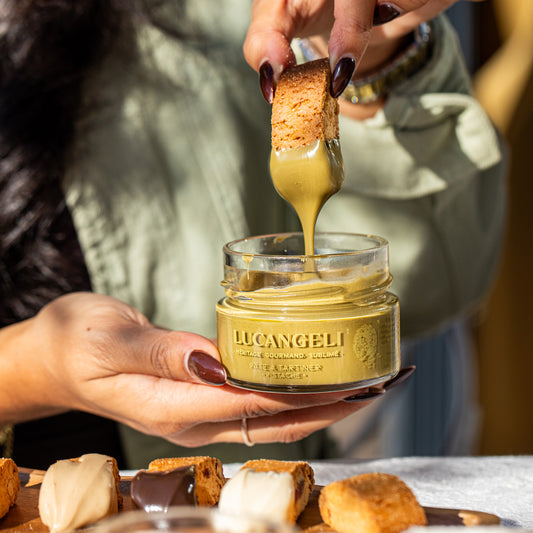
Pistachios play a central role in Sicilian and Italian pastry in general. They are found in cannoli filled with pistachio ricotta, cassata, granitas, amaretti biscuits, and artisanal ice creams. In pastry, they come in several forms: whole for decoration and crunch, powdered for batters, or as a paste for creams and fillings. The pistachio spread — without palm oil — is an accessible and gourmet version of this tradition, ideal for filling crepes, brioches, or tarts.
In Savory Cooking: A Growing Trend
Pistachios are not just for desserts. In contemporary Italian cuisine, they are used in many savory dishes: pistachio pesto to accompany fresh pasta, pistachio breading for meats or fish, arancini filled with pistachio cream and mortadella, or burrata-pistachio-mortadella pizza, which has become a classic in the best Italian pizzerias. Pistachios add crunch, color, and a slightly sweet flavor that balances savory preparations.
In Professional Format: 100% Purée
For demanding chefs, pastry chefs, and enthusiasts, 100% pistachio purée is the go-to format. Obtained by grinding roasted pistachios without added sugar, oil, or flavor, it offers maximum flavor concentration. It is used to flavor pastry creams, ganaches, ice creams, or sauces. 100% pistachio purée is available in a 1 kg format, suitable for regular use in the kitchen. In the same range, you can also find 100% Piedmont hazelnut purée and 100% almond purée, to vary creations based on Italian nuts.
How to Choose Your Italian Pistachios Well?
Whole, Purée, or Spread: Which Format for Which Use?
The choice of format depends on the intended use. Whole, unsalted pistachios are suitable for decorations, nut mixes, or preparations where crunchiness is desired. Pistachio powder can be incorporated into cake batters or creams. 100% purée is ideal for professional or home preparations requiring an intense flavor without added sugar. The pistachio spread, on the other hand, is perfect for direct consumption or for filling pastries and everyday desserts.
Reading Labels: What to Check
To ensure the quality of a pistachio-based product, a few points should be checked on the label: the pistachio content (the higher, the better the quality), the absence of palm oil, artificial flavors, or colorings. The DOP or IGP mention is an indicator of controlled origin. Beware of pistachio pastes with too vivid a green color: the natural color of pistachios is a soft green, sometimes slightly greyish after processing.
Pairing Pistachios with Other Italian Nuts

Pistachios pair very well with other nuts from the Italian terroir. Piedmont IGP hazelnuts, with their buttery and roasted notes, perfectly complement pistachios in spreads. The hazelnut spread or the almond spread are excellent alternatives to vary the pleasures. To discover several flavors at once, the set of 5 spreads allows you to explore the entire range — pistachio, hazelnut, almond, cocoa-hazelnut, and bergamot — in an ideal format for gifting or treating yourself. The bergamot spread, awarded at the Épicures Or 2024, brings a very original citrus and floral note, typical of Calabria. To create a custom gourmet gift box around Italian nuts, the gift box to compose allows you to freely select products according to your desires.



 lucangeli.it