

The Italian pistachio holds a special place in Mediterranean gastronomy. Cultivated on the slopes of Mount Etna, in the Sicilian municipality of Bronte, it is renowned worldwide for its intense green color and deep, slightly sweet, and woody flavor. Nicknamed "green gold," it has benefited from a European Protected Designation of Origin (PDO) since 2010—a rare distinction that attests to the nut's deep roots in Italian terroir and culinary culture.
The origins of the Bronte pistachio: a journey from the Middle East
From Arab caravans to the volcanic lands of Sicily
The history of the pistachio in Italy begins with the Arabs, who introduced the pistachio tree to Sicily between the 8th and 9th centuries. The word "pistachio" itself derives from Arabic terms—fristach, frastuch—which referred to the fruit and the tree in the Maghreb and Middle East regions. By settling in the volcanic lands of the Catania province, the pistachio tree gradually evolved to give birth to a unique variety: the Pistacchia vera di Bronte. To explore other flavors from Italian terroir, discover our organic green fruity olive oil, cold-pressed in Calabria.
An exceptional terroir between lava and altitude
The Bronte pistachio grows only between 400 and 900 meters above sea level, on soils formed from the lava flows of Etna. This volcanic substrate gives the fruit its characteristic green color and distinctive taste. The region's climate—hot, dry summers and mild winters—creates ideal conditions for the pistachio tree. The harvest, manual and demanding, occurs only every two years: the resting years allow the tree to concentrate all its energy on producing superior quality fruits. This slowness and rigor are reminiscent of the artisanal approach found in products like our pistachio spread, made without palm oil.
PDO: a well-deserved European recognition
In 2010, the Pistacchio Verde di Bronte obtained the Protected Designation of Origin (PDO) from the European Union. This label guarantees that the pistachio is cultivated, harvested, and processed exclusively within the delimited area around Bronte, Biancavilla, and Adrano. Today, over 80% of the production is exported, proving the global reputation of this nut. Only 1% of the pistachios in circulation worldwide come from Bronte—making it a rare and precious ingredient. For lovers of exceptional Italian products, our gourmet gift set allows you to create a personalized selection of these terroir treasures.
Pistachio in Italian cuisine: from sweet to savory

In pastries and desserts
Bronte pistachio is an essential ingredient in Sicilian pastry. It is used in cannoli, granitas, artisanal ice creams, and nougats. Its natural green color and intense aroma make it a choice ingredient for pastry chefs. In home cooking, 100% pistachio puree makes it easy to create creams, ganaches, or fillings for tarts and cakes. It can be used equally well in a panna cotta or a revisited frangipane tart.
In savory cuisine: a versatile ingredient
Pistachio is not reserved for desserts. In Italian cuisine, it accompanies white meats, fish, and cheeses. It is used in some pestos, stuffings for cured meats (like mortadella from Bologna), and risottos. For an original homemade pesto, you can combine crushed pistachios, fresh basil, and a good olive oil—like our PDO basil pesto, which illustrates the importance of origin labels in Italian gastronomy.
Pistachio paste: a concentrate of flavor
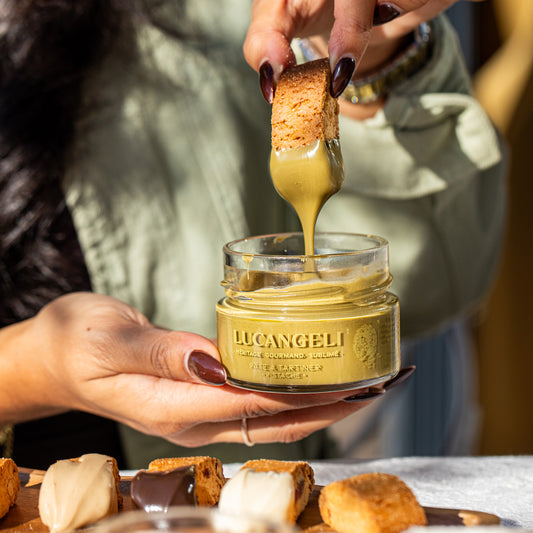
Pistachio paste—or pasta di pistacchio—is one of the most commonly used forms in professional and artisanal cooking. It is prepared by grinding roasted pistachios until a smooth and creamy texture is obtained. It can be incorporated into pastry creams, mousses, ice creams, or simply spread on bread. Our pistachio spread is made without palm oil, with a rigorous selection of pistachios for an authentic result. For variety lovers, the spread assortment brings together pistachio, hazelnut, almond, and cocoa in one gourmet set.
How to choose and use quality pistachio paste
The criteria for a good pistachio paste

To recognize a quality pistachio paste, several criteria should be observed: the color (natural green, no artificial colorings), the ingredient list (pistachios first, no palm oil or artificial flavors), and the texture (smooth but dense). A quality paste should smell of fresh pistachio, with a slight woody note. Conversely, a paste that is too light or too sweet often indicates a low pistachio content. Our 100% pistachio puree meets these criteria: a single ingredient, no additives.
Gourmet pairings and combinations
Pistachio naturally pairs well with dark chocolate, vanilla, lemon, and citrus fruits. It also combines very well with other nuts: hazelnut, almond, cashew. To explore these combinations, our Piedmont hazelnut spread and our almond spread offer complementary aromatic profiles. In cooking, pistachio integrates equally well into a brunch or a gourmet meal—its versatility makes it a choice ingredient for curious cooks.
Storage and daily use
Pistachio paste should be stored at room temperature, away from light and heat. Once opened, it is advisable to consume it within a few weeks to preserve its aromas. It can be used directly with a spoon, incorporated into a cake batter, diluted in a little cream for a dessert sauce, or mixed with yogurt for a gourmet breakfast. To offer a complete experience of Italian flavors, a gourmet gift card allows everyone to create their own selection according to their desires.



 lucangeli.it