

As the new school year approaches, the same question comes up every year: how to choose a quality, palm-oil-free spread for breakfast or a snack? Between major industrial brands and artisanal alternatives, it's not always easy to navigate. Here are the essential criteria for making an informed choice.
Why avoid palm oil in spreads?
Palm oil is one of the most widely used fats in the food industry. Inexpensive, heat-stable, and with a creamy texture, it has become a staple in many spread recipes. However, its presence raises two major types of concerns.
Documented environmental impact
Palm oil production is directly linked to massive deforestation in Southeast Asia, particularly in Indonesia and Malaysia. Millions of hectares of primary forests have been cleared to make way for oil palm monocultures, with significant consequences for biodiversity and local ecosystems. Choosing a palm-oil-free spread is therefore also an act for the environment.
A composition to monitor
From a nutritional standpoint, palm oil is particularly rich in saturated fatty acids. While occasional consumption is not a problem, its presence at the top of the ingredient list in a spread consumed daily warrants attention. Vegetable alternatives—sunflower oil, rapeseed oil—are generally preferred in quality artisanal recipes.
How to read a spread label?

Before buying, a few seconds spent reading the label can make the difference between a quality product and a standard industrial product.
Nut content: the primary criterion
This is the most telling indicator. In a classic industrial spread, the hazelnut content is around 13%. In a quality artisanal spread, this content often exceeds 30 to 40%. The Piedmont hazelnut spread is a good example: made from IGP hazelnuts of the Tonda Gentile Trilobata variety, it puts the nut first, for a deep and authentic flavor.
Ingredient order: a simple rule
European regulations require ingredients to be listed in descending order of quantity. If sugar or palm oil appear first, the product is primarily composed of these elements. Conversely, a quality almond spread or pistachio spread will list the nut at the top. This is a reliable indicator for assessing the product's actual composition.
The length of the ingredient list
The shorter the list, the closer the product is to an artisanal recipe. A quality chocolate hazelnut spread does not need emulsifiers, artificial flavors, or preservatives to be delicious. The simplicity of ingredients is often a sign of mastered craftsmanship and carefully selected raw materials.
What artisanal alternatives to industrial spreads?
The market for palm-oil-free spreads has grown considerably in recent years. Several major families of alternatives can be distinguished, depending on the nut used.
Hazelnut-based spreads
Hazelnut remains the reference nut for spreads. The Tonda Gentile Trilobata variety from Piedmont, protected by the IGP label, is renowned for its intense taste and melting texture. The 100% Piedmont hazelnut paste — composed of a single ingredient — perfectly illustrates what a nut can yield when processed without unnecessary additions. For a more gourmet version, the Piedmont hazelnut spread combines this exceptional nut with a balanced, palm-oil-free recipe.
Pistachio or almond-based spreads
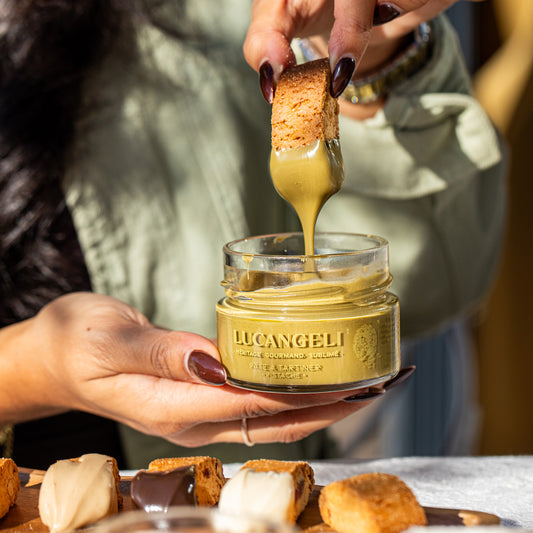
Sicilian pistachio and Italian almond offer very different, but equally interesting, aromatic profiles from hazelnut. The pistachio spread seduces with its natural green color and slightly vegetal taste. The almond spread, milder, is particularly suitable for breakfasts and brunches. For catering or pastry professionals, the 100% pistachio paste and 100% almond paste allow these raw materials to be worked in their purest form.
Original creations: bergamot, cocoa and unprecedented combinations

Beyond the classics, some artisanal houses offer more original combinations. The bergamot spread — awarded the Gold Medal at the Épicures 2024 — is an example of a creation that breaks new ground: the emblematic Calabrian citrus brings a floral and tangy note that transforms breakfast. For those who want to explore several flavors, the set of 5 spreads allows you to discover the entire range in a single box. And for gifting, the customizable gift box is an ideal option for back to school or any gourmet occasion.
Frequently Asked Questions about Palm Oil-Free Spreads
Why are palm oil-free spreads sometimes more expensive?
Artisanal alternatives use larger quantities of higher quality nuts. The cost of raw materials — IGP Piedmont hazelnuts, Sicilian pistachios, Italian almonds — is naturally higher than that of palm oil. This additional cost is directly reflected in the final price, but also in the product's taste quality.
Does a palm oil-free spread keep as well?
Palm oil plays a stabilizing role in industrial recipes. Without it, a slight separation of fat may appear on the surface of the jar after a few days. This phenomenon, called phase separation, is completely natural and does not alter the quality of the product. Simply stir before use.
Can these spreads be used in cooking or baking?
Absolutely. Artisanal nut-based spreads integrate very well into sweet recipes: cakes, creams, pie fillings, ice cream sauces. 100% nut pastes — 100% Piedmont hazelnut paste, 100% pistachio paste, 100% almond paste — are particularly suitable for professional use or home baking.




 lucangeli.it