

Why is Italian pistachio spread so popular?
Italian pistachio spread wins people over with its bright colour, its intense aroma and its creamy texture. But between industrial recipes and genuine artisan specialities, there is a world of difference! To be sure you are choosing an authentic spread, look at the ingredient list, where the pistachios come from and the producer's know-how. In Calabria and Sicily, the pistachio is an exceptional product, celebrated at local festivals and used in many traditional desserts.
- A real pistachio spread contains at least 30% pistachios, and often far more in premium versions.
- Sugar is never the main ingredient: it is only there to round out the flavour.
- No palm oil and no artificial flavouring should appear on the label.
- The origin of the pistachios (Bronte in Sicily, or Calabria) guarantees a unique aroma.
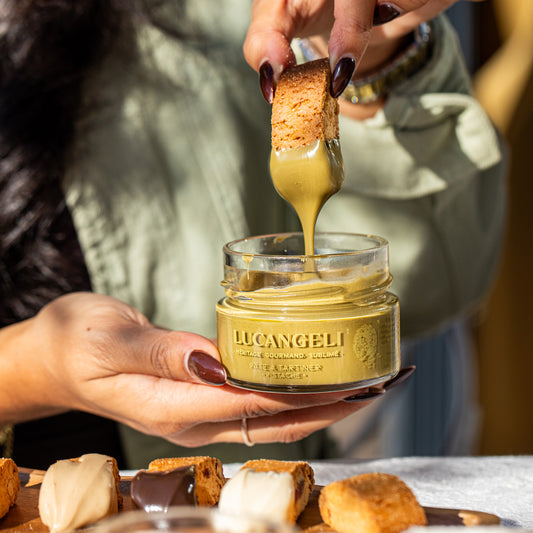
Take a look at the artisan pistachio spread as an example of Italian standards.

Find other specialities on the sweet grocery page or explore the 100% pistachio purée, 1 kg for big gatherings.
The making of an artisan pistachio spread
The ingredients and processes that make the difference
A pistachio spread worthy of the name uses pistachios roasted all the way through, finely ground and worked at low temperature to preserve their aroma. Milk or cocoa butter is sometimes added for texture, but never to mask the taste of the pistachio.
- The colour should be natural, slightly green, never neon.
- The texture is supple, neither runny nor solid.
- The pistachio taste dominates, without too much sugar or flavouring.
The Lucangeli pistachio spread shows what that standard looks like: no palm oil, rich in pistachios, faithful to the tradition of southern Italy.
For professionals or large families, the 1 kg pistachio purée guarantees a pure product, with no added sugar and no preservatives, perfect for pastry work.
Telling a real pistachio spread from an imitation
Here is how to avoid getting it wrong when you buy:
- Read the ingredient list: pistachio first!
- Go for protected origins or artisan producers.
- Avoid products that are very sweet or very cheap.
- Go for creamy textures, with no layer of oil on the surface.
- Look for labels or origin markings (Italy, Bronte, Calabria).
How to use pistachio spread like a gourmet
Tasty ideas for every occasion
Italian pistachio spread is not just for breakfast toast. It also lifts crêpes and waffles, as well as more creative desserts such as a reinvented tiramisu, panna cotta or panettone.
- By the spoonful, on a slice of brioche bread.
- As a filling for homemade croissants or brioches.
- As a topping on vanilla ice cream or on a chocolate cake.
- In a glass dessert, paired with fresh seasonal fruit.

Find more inspiration on the spreads page and put together a gourmet set to vary the pleasures.
Professionals can also work the 100% pistachio purée into their pastry creations, for an authentic and controlled result.
Frequently asked questions
How do you recognise a real Italian pistachio spread?
Read the ingredient list: pistachio should come first, with no palm oil and no colouring. Go for Italian origin, especially Bronte or Calabria.
Can pistachio spread be used in pastry?
Yes, it is a great replacement for pistachio cream in desserts: fillings, ganaches, mousses, or as a topping.
What is the difference between pistachio spread and pistachio purée?
The spread contains sugar and sometimes milk; the purée is 100% pistachio, ideal for professional kitchens or sugar-free recipes.



 lucangeli.it