

Why autumn is the right time to review your olive oils
The change of season, a signal for the menu
Every menu change is an opportunity to re-evaluate your supplies. In autumn, dishes evolve: roasted vegetables, mushrooms, braised meats and legumes replace the raw vegetables and grilled fish of summer. These preparations call for olive oils with different, more structured, more pronounced profiles, capable of standing up to intense flavors.
It is also the time when teams get back into their rhythm after the summer. Reviewing your professional olive oil references in September means ensuring you enter the season with the right tools, without stock shortages or unpleasant surprises with the first order.
What customers expect in autumn
Customer expectations evolve with the season. In autumn, they look for dishes with body, distinct flavors, and a certain generosity. A well-chosen finishing olive oil contributes to this perception: a drizzle of organic green fruity oil on a butternut squash soup, or a few drops of flavored oil on a mushroom carpaccio, create a signature that the customer perceives without necessarily identifying it.
The seasonality of olive oil itself is an argument to highlight. The olive harvest in Calabria begins in October. New oil, cold-pressed in the weeks following the harvest, arrives on the market between November and December. Announcing the arrival of a new harvest oil on your menu is a sign of freshness and traceability that few establishments still exploit.
Which olive oils to choose for an autumn menu?

Green fruity or ripe fruity: the right choice depending on the dishes
The distinction between green fruity and ripe fruity is the first decision to make. It determines the pairing with the dishes on the menu.
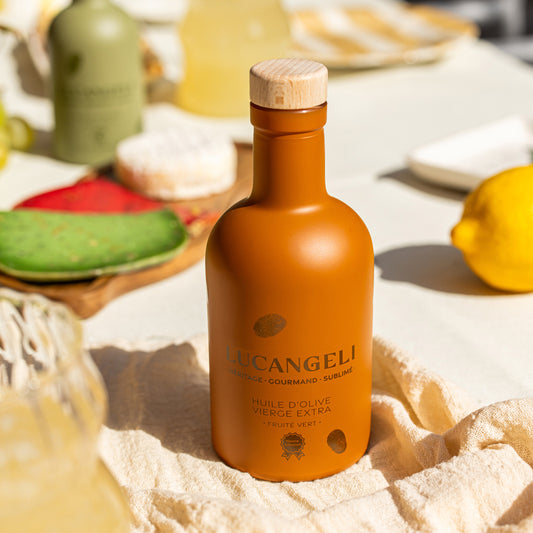
Green fruity is obtained from olives harvested before full maturity. It is characterized by vegetal notes, a frank bitterness, and a pungency at the end of the mouth. The Coratina variety, originally from Puglia and also cultivated in Calabria, is the most representative example: marked bitterness and pungency, intense profile, ideal for flavorful dishes. Organic green fruity olive oil is particularly well suited as a finish on roasted meats, bitter vegetables like radicchio or black cabbage, and aged cheeses.
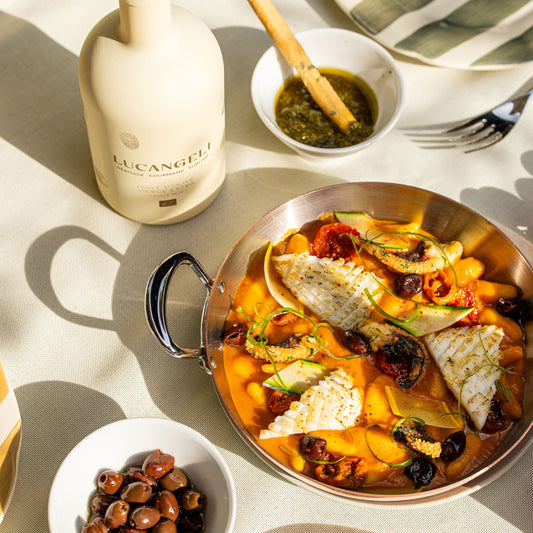
Ripe fruity comes from olives harvested at advanced maturity. It offers sweet, fruity notes, sometimes buttery or almond-like. The Carolea variety, typical of Calabria, is an illustration of this: almond and apple notes, slight pungency, accessible profile. It pairs well with more delicate dishes. Organic ripe fruity olive oil is a standard for table service, both for complimentary bread and for finishing risottos, velvety soups, and fresh pasta on the plate.
For establishments that wish to offer both profiles without multiplying references, the 500 ml discovery duo bottles allow you to test both styles before defining your order volumes for the season.
Compared selection: four profiles for the autumn menu
Here are the four profiles to consider for an autumn menu, with their recommended uses:
- Green fruity (Coratina): vegetal notes, marked bitterness and pungency. Uses: roasted meats, bitter vegetables, aged cheeses, finishing on flavorful dishes. Recommended format: 200 ml organic bottle.
- Ripe fruity (Carolea): almond and apple notes, slight pungency. Uses: risottos, velvety soups, fish in sauce, fresh pasta, complimentary bread. Recommended format: 1 L limited edition bottle.
- Bergamot flavored (Calabrian co-milled): citrus and floral profile. Uses: white fish, shellfish, autumn salads, citrus desserts. Recommended format: 200 ml bottle.
- Garlic and chili flavored (organic extra virgin): spicy and warm profile. Uses: pasta, legumes, bruschetta, roasted vegetables. Recommended format: 200 ml organic bottle.
- Cooking and volume (organic extra virgin): neutral and stable profile. Uses: cooking, marinades, sauces, large quantity preparations. Recommended format: 5 L professional can.
Flavored oils, a lever for differentiation
Flavored oils hold a special place on an autumn menu. They do not replace a quality extra virgin oil, but they allow for unexpected pairings and to sign certain dishes.
The bergamot olive oil, awarded at the Épicures d'Argent 2023, is obtained by co-milling Calabrian bergamot with olives, which distinguishes it from an oil simply flavored by adding extract. Its citrus and slightly floral profile pairs well with white fish, shellfish, autumn salads, and citrus-based desserts. It is a table service reference that consistently sparks customer curiosity.
The organic garlic and chili olive oil is suitable for southern dishes: pasta, roasted vegetables, legume soups, bruschetta. It can be offered as a table condiment or used as a finishing touch in the kitchen.
How to integrate olive oil into autumn dishes
Uses in the kitchen: cooking, finishing, marinating
In professional kitchens, olive oil fulfills three distinct functions that call for different references.
- Cooking: For medium-heat cooking, sautéed vegetables, pan-fried mushrooms, pan-fried fish, a good quality common extra virgin olive oil is sufficient. The 5-liter professional can is the appropriate format to control material costs for these uses. A 5-liter can can provide approximately 400 standard cooking portions at 12 ml, resulting in a very contained material cost per plate.
- Finishing: This is where the quality of the oil is most perceptible. A drizzle of oil added off the heat, just before serving, brings an aromatic dimension that cooking cannot reproduce. For this use, a flavorful green fruity oil or a flavored oil is preferable. The dose is small, 3 to 5 ml per plate, which economically justifies the use of a premium reference.
- Marinating: For marinated meats and vegetables, a good quality extra virgin olive oil is sufficient. It can be combined with herbs, lemon, or spices depending on the dish. The organic extra virgin jeroboam is an option for establishments that want an original presentation format in the dining room or buffet.
Highlighting in the dining room
Olive oil on the table is a ritual that is being re-established in many establishments, particularly in Mediterranean or Italian-inspired restaurants. In autumn, this ritual can be renewed with a new reference, presented by the waiting staff as a seasonal product.
Briefly training the waiting staff on two or three points is sufficient: the oil's profile (green or ripe fruity), the olive variety used, and a simple pairing with a dish on the menu. This pitch, delivered in thirty seconds, enhances the product and creates a memorable experience for the customer.
For establishments that wish to go further, bottle personalization is an option to consider from the start of the season: a bottle with the establishment's identity, placed on each table, reinforces the coherence of the experience and constitutes a discreet but effective communication medium. The production time is approximately three weeks from the validation of the design, which means initiating the process in September for implementation in October.
For any volume request or professional referencing, the space dedicated to catering professionals allows you to contact the sales department and obtain conditions adapted to your establishment.
Frequently asked questions
Which olive oil should I choose to update my autumn menu in a restaurant?
The choice depends on the dishes on the menu. For flavorful preparations, roasted meats, bitter vegetables, cheeses, a green fruity oil made from Coratina is recommended. For milder dishes, risottos, velvety soups, fish, a ripe fruity oil made from Carolea is more suitable. A flavored oil (bergamot, garlic-chili) can complete the selection to create original pairings.
When does the new harvest olive oil arrive and how can it be integrated into the menu?
The olive harvest in Calabria begins in October. New oil is available between November and December. Announcing its arrival on the menu or on a chalkboard in the dining room is an argument for freshness and traceability that customers appreciate. It is also an opportunity to renew the presentation of olive oil on the table.
Which olive oil format is most suitable for a restaurant in terms of material cost?
For cooking and large-volume preparations, the 5-liter can is the most economical format. For finishing on the plate and table service, 200 ml to 1 liter bottles allow for offering a premium reference without the risk of oxidation associated with a large open volume. The general rule: adapt the format to the actual rotation of the product in your kitchen.




 lucangeli.it