

A drizzle of olive oil at the last minute can transform a dish. In professional catering, finishing oil is not just an accessory condiment: it's a dressing tool in its own right, just like sauce or garnish. However, you still need to choose the right oil, at the right time, and know how to portion it.
Finishing olive oil: a technical gesture, not a reflex
What distinguishes a cooking oil from a finishing oil
In professional cooking, two uses coexist and should not be confused. Cooking oil withstands heat; it's incorporated into the dish during preparation. Finishing oil, on the other hand, is added off the heat, during plating or just before serving. Its role is sensory: it provides shine, aroma, and a lingering taste without undergoing thermal transformation.
For pan-frying or baking, a 5-liter organic olive oil canister offers the right quality-to-volume ratio for daily use in a professional kitchen. For finishing, it's a different logic: you choose an oil whose aromatic profile complements the dish.
Why chefs use olive oil for finishing
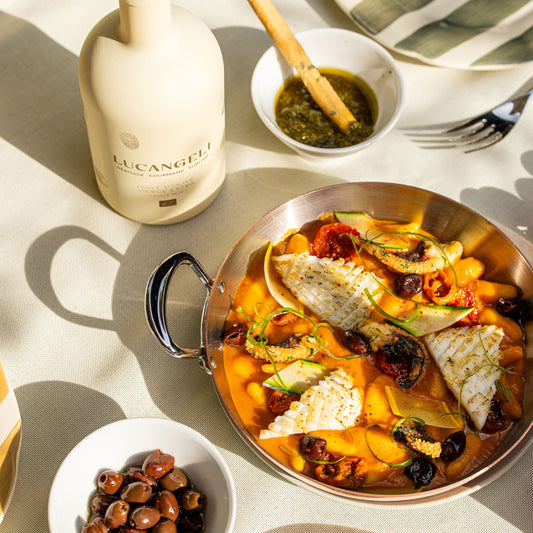
The answer is simple: a quality extra virgin oil provides what neither butter nor cream can. A slight bitterness, a pungent finish, and vegetal aromas that awaken the entire plate. On a beef carpaccio, a risotto, a cold vegetable soup, or steamed fish, the drizzle of raw oil makes the difference between a decent dish and a memorable one.
It's also a visible gesture. Poured in front of the customer, it signals the care taken with the product. It tells a story about the establishment's cuisine. To discover formats suitable for professional service, consult the dedicated space for establishments.
Dosing: a matter of precision
A drizzle of finishing oil is measured in grams, not spoonfuls. In practice, between 3 and 8 grams per plate depending on the dish. Too little, the effect is imperceptible. Too much, the oil overwhelms other flavors and visually heavy-handedly affects the presentation. A non-drip pourer or a serving pipette allows for precise flow control, especially during busy periods. The limited edition fruity ripe olive oil is packaged in a bottle suitable for this type of precise service.
Which oil to choose depending on the dish and aromatic profile

Green fruitiness or ripe fruitiness: two families, two uses
The choice of finishing oil primarily depends on the dish's aromatic profile. Two main families are distinguished, with very distinct uses.
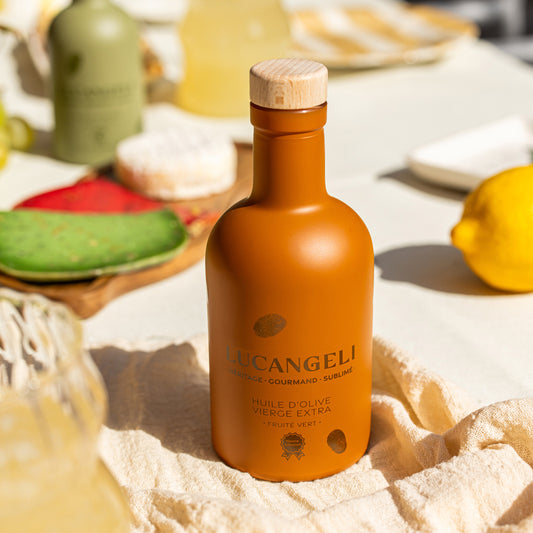
Green fruitiness is characterized by notes of fresh grass, raw artichoke, and green almond, with a marked pungency. It is suitable for raw fish, steamed vegetables, salads, and fresh cheeses. An organic green fruity olive oil is perfect for finishing a sea bream tartare or burrata.
Ripe fruitiness presents notes of ripe tomato, black olive, and dried fruits, with a mild pungency. It pairs well with white meats, pasta, risotto, and roasted vegetables. An organic ripe fruity olive oil goes better with a mushroom risotto or a roasted veal chop.
Carolea: a Calabrian variety to know
Among the varieties used in Calabrian olive oils, Carolea deserves special attention. It is one of the dominant varieties in the region, harvested between October and December. Its tasting profile is characterized by a pronounced ripe fruitiness, notes of candied tomato and cooked artichoke, moderate bitterness, and a mild pungency at the finish. It is particularly suitable for finishing hot dishes, where its aromas are released upon contact with the residual heat of the plate.
The limited edition fruity ripe olive oil comes from this Calabrian tradition and can be offered as a signature finishing oil in your establishment.
Flavored oils: a tool for differentiation
Beyond natural oils, flavored oils open up a field of creativity for chefs who wish to create a signature dish. Two production methods should be distinguished: infused oil, obtained by co-crushing the fruit with the olives during milling, and flavored oil, obtained by adding aroma after extraction. The first offers a deeper and more stable aromatic integration.
The bergamot olive oil awarded at the Épicures d'Argent 2023 is obtained by co-crushing. When used as a finish on white fish, poultry, or even panna cotta, it brings an immediately identifiable citrus-floral note. This is the type of detail that builds a menu's identity.
Integrating finishing oil into table service
Service format: bottle, carafe, or pourer
The format in which the oil is presented at the table speaks as much as the oil itself. Three options are available:
- The original bottle at the pass: practical for the kitchen staff, but with no presentation value for the customer.
- The carafe or serving bottle: allows a small amount to be transferred daily, limits oxidation, and ensures a neat presentation when plating.
- The personalized bottle on the table: reserved for establishments that want to make olive oil an element of their visual identity. The jeroboam of organic extra virgin olive oil is designed for this type of presentation, especially for large tables or buffets.
The personalized bottle as a communication tool
More and more establishments are choosing a branded bottle with their logo or graphic charter. This is a communication investment that quickly pays for itself: the bottle is photographed, shared, and commented on. It reinforces the consistency of the customer experience from appetizer to dessert.

The personalized bottle service for your establishment is available from 24 bottles, with a production time of 10 to 15 working days. For a custom project or a large volume, the professional space allows you to contact the sales department and obtain a quote tailored to your establishment.
Training the front-of-house team on oil discourse
A server capable of explaining in two sentences why the oil poured on a dish is a Calabrian green fruitiness, and what it adds to the tasting experience, transforms a technical gesture into a moment of transmission. This is not long training: it's a product sheet, a tasting during a team meeting, and a few keywords to remember. The result is immediate on the customer's perception of quality. To structure this approach, the space dedicated to catering professionals offers tailored support.
Frequently asked questions
Which olive oil should be used to finish a dish in a restaurant?
Choose an extra virgin olive oil whose aromatic profile complements the dish: green fruitiness for raw fish and steamed vegetables, ripe fruitiness for meats and pasta. Finishing oil should never have been heated. An organic green fruity olive oil or an organic ripe fruity olive oil are two suitable options for this use.
How many grams of olive oil to finish a dish?
Between 3 and 8 grams depending on the dish. A non-drip pourer or serving pipette allows for precise dosing during service. Beyond 10 grams, the oil becomes visually dominant and can mask other flavors.
How can I offer personalized olive oil in my restaurant?
It is possible to order branded bottles starting from 24 units, with a lead time of 10 to 15 working days. For a professional project, contact the sales department via the dedicated space for establishments.



 lucangeli.it