

Before you spread anything, serve it right: the details that make the difference
Artisan panettone deserves a little attention before it even reaches the table. One simple step changes everything: take it out of its packaging at least 20 minutes before serving. The crumb, dense and open-textured, softens again at room temperature and releases its aromas of butter, candied zest and vanilla far better. Kept somewhere cool and dry — never in the fridge, which dries the crumb out — a good artisan panettone keeps easily for two to three weeks after opening, as long as you reseal the bag or wrap it in baking paper.
For slicing, Lombard tradition calls for vertical slices about 2 centimetres thick, cut from the top down to the base, the way you would cut a round cake. That thickness keeps the crumb from crumbling and gives you a generous surface for a topping. A long, lightly serrated blade gives the cleanest result.
Those two details — serving temperature and slicing — are already enough to change the overall impression. The rest comes down to what you put on top.
Which toppings should you choose for panettone?

Italian spreads: the most generous topping
The most natural topping for a slice of panettone is a good spread. The brioche-like crumb, already rich in butter and sugar, calls for something intense and concentrated rather than a simple jam. That is exactly where Italian artisan spreads come into their own.
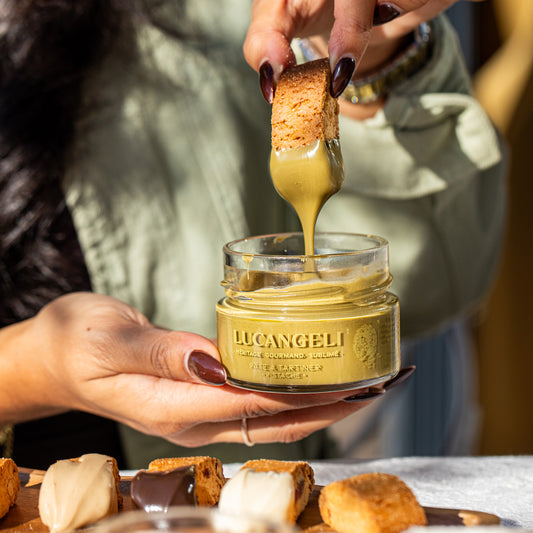
The pistachio spread is the most accomplished pairing: the slight bitterness of the pistachio cuts through the sweetness of the crumb and creates a balance you will not find with butter or jam. Go for a spread with no palm oil, made with Italian pistachios for a clean, direct aromatic profile.
The Piedmont hazelnut spread plays in a rounder, gentler register, with the toasted aromas specific to Piedmont PGI hazelnuts. It is the ideal topping for morning slices, on a light panettone with raisins or classic candied fruit.
For those who like contrast, the Piedmont cocoa and hazelnut spread brings a chocolate note that recalls Italian festive desserts without weighing everything down. A thin layer is enough.
Finally, the most unexpected pairing, and often the most memorable, is the bergamot spread, awarded at the Épicures d'Or 2024: Calabrian bergamot brings a citrus brightness that wakes up the panettone crumb and echoes the candied zest already in it. A pairing nobody sees coming and everybody remembers.
100% purees for those who prefer unadulterated products
For anyone who prefers a topping with no added sugar, the 1 kg nut purees open up different possibilities. The 100% pistachio puree can be used as it is, straight from the spoon, or warmed slightly to make it more fluid and spread it on a still-warm slice. The result is more intense, more direct than a sweetened spread.
The 100% Piedmont hazelnut puree works the same way. It can also serve as the base for a quick ganache (puree + melted chocolate + a splash of cream) poured over the slices for an improvised dessert in a few minutes.
These purees are naturally free of palm oil, added sugar and emulsifiers. They keep at room temperature before opening, then in the fridge once open.
Classic toppings and small extras
The table below sums up the most common toppings and their respective profiles, to help you choose according to the moment and the panettone you have:
The Modena PGI balsamic vinegar, Gold collection deserves a special mention: a few drops on a slice of panettone served with a fresh fig or a piece of aged cheese make a pairing worthy of the end of an Italian meal. It is a little-known use outside Italy, but one regularly practised in the households of Modena and Bologna.
What to do with leftover panettone? Three simple ideas
Panettone perdu, the Italian take on French toast
Stale panettone crumb is perfect for an enriched version of French toast. Cut the remaining slices in half through their thickness, dip them in a mix of beaten eggs, whole milk and a little vanilla, then brown them in a pan with a knob of butter. Serve with a spoonful of warmed almond spread or lightly melted hazelnut puree.
Panettone tiramisu
Swap the ladyfingers for slices of panettone cut into cubes. Dip them briefly in cooled strong coffee, arrange them in a dish, cover with mascarpone cream and start again. The result is softer and more fragrant than a classic tiramisu, with notes of candied citrus coming through in every mouthful.
The next day's toasted slice
The simplest move, and often the best: toast a slice of stale panettone for a few minutes under the oven grill or in a toaster set to minimum. The crumb turns lightly crisp on the surface while the inside stays tender. Top it straight away with a generous spoonful of pistachio spread or hazelnut puree. This is the breakfast of a holiday morning that carries on.
If you want to put together an assortment to give as a gift or to try several toppings, the set of five spreads brings the classics together in a single box, easy to slip in alongside a fine artisan panettone for a seasonal food gift.
Frequently asked questions about panettone toppings
How do you store an opened artisan panettone?
Carefully reseal the original packaging or wrap the panettone in baking paper, then keep it somewhere at room temperature, away from light and humidity. Avoid the fridge, which dries the crumb out within hours. Stored this way, an opened artisan panettone keeps for 10 to 15 days without losing its texture.
Can you freeze panettone?
Yes, panettone freezes very well in individual slices wrapped in cling film. To serve, let it thaw at room temperature for two hours, or put the slices straight into the toaster. It is a practical way to spread consumption over several weeks after the holidays.
How much topping should you allow per slice?
A level tablespoon (around 15 to 20 g) of spread is enough for a standard 2 cm slice. For 100% nut purees, a smaller amount — a teaspoon — is generally enough, as their flavour is more concentrated. The build-your-own gift box lets you combine several toppings for a comparative tasting at the table.




 lucangeli.it