

Criteria for recognizing an artisanal panettone
An artisanal panettone can be distinguished from an industrial one just by reading the label. Three indicators are enough to sort them out before even opening the box.
Natural sourdough, the first indicator
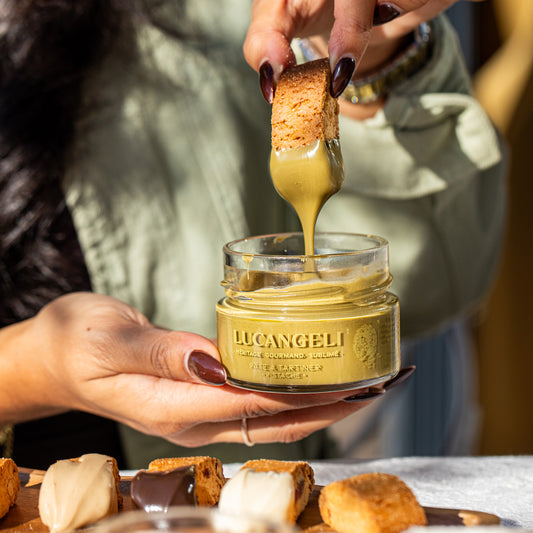
Natural sourdough, called lievito madre in Italian, is the hallmark of a quality panettone. It is a living fermentation culture, maintained for years by artisans, which gives the crumb its characteristic lightness and complex aromas. A panettone made with natural sourdough requires between 36 and 72 hours of fermentation. On the label, look for the mention "lievito madre" or "natural sourdough" in the list of ingredients. If you don't find it, the product is made with chemical yeast or industrial baker's yeast, which radically changes the taste. To garnish a slice of sourdough panettone, a pistachio spread without palm oil brings a sweetness that perfectly matches the brioche notes of the sourdough.
The crumb, texture and color
An artisanal crumb is stringy, airy, and slightly moist. When you cut a slice, the dough strands stretch without tearing. The color should be golden on the outside, pale yellow on the inside. A crumb that is too compact, too dry, or too uniform betrays a short fermentation or an industrial formulation. The crust should be thin and slightly crispy, never thick or rubbery. Piedmont hazelnut spread, with its intense roasted hazelnut taste, enhances this stringy texture without crushing it.
The ingredient list, the real test
An artisanal panettone contains few ingredients: flour, butter, eggs, sugar, sourdough, candied fruit or raisins, citrus zest. The list should be short and legible. The longer it is, the more industrial the product. Pay particular attention to the order of ingredients: butter should appear prominently, a sign of a generous recipe. The cocoa hazelnut version is an ideal topping for lovers of more intense flavors, to be spread generously on a thick slice.
Artisanal vs. industrial panettone: what the label says
Here are the six criteria that distinguish an artisanal panettone from an industrial one:
- Sourdough: lievito madre (natural sourdough) for artisanal, chemical yeast or baker's yeast for industrial.
- Fermentation time: 36 to 72 hours for artisanal, 4 to 8 hours for industrial.
- Ingredients: short list with butter at the top for artisanal, long list with artificial flavors for industrial.
- Crumb texture: stringy, airy and slightly moist for artisanal, compact, dry and uniform for industrial.
- Shelf life: 30 to 60 days under protective atmosphere for artisanal, 90 to 180 days with preservatives for industrial.
- Indicative price: 25 to 60 euros per kilo for artisanal, 5 to 15 euros per kilo for industrial.
Ingredients to avoid
Certain ingredients immediately signal a lower quality panettone: artificial flavors (vanillin, butter flavor), emulsifiers (large quantities of soy lecithin, mono- and diglycerides), preservatives (sorbic acid, potassium sorbate) and vegetable oils replacing butter. These additions reduce costs and extend shelf life, but they alter the taste and texture. An almond spread without additives, made only from nuts, is the logical counterpart to an artisanal panettone: two products that share the same philosophy of short ingredient lists.
Fermentation time and what it changes
Long fermentation with natural sourdough develops organic acids that give the panettone its slightly acidic taste, natural preservation, and digestibility. A panettone fermented for 48 hours has an incomparably more complex aromatic profile than a panettone fermented for 6 hours. This also explains the price difference: the working time is real, potential losses exist, and mastering sourdough requires years of practice. For professionals who wish to offer a quality filling to their customers, 1 kg Piedmont hazelnut puree offers a 100% hazelnut base, with no added sugar, ideal for filling panettone slices for table service.
How to serve and garnish an artisanal panettone
Cutting and serving temperature
Panettone should be served at room temperature, never straight from the refrigerator. Cold solidifies the butter and hardens the crumb, which dulls the aromas. Take it out at least an hour before serving. For slicing, use a long, slightly serrated knife. Milanese tradition dictates that panettone be cut into vertical slices, from top to bottom, like a cake. Each slice should be about two centimeters thick so that the crumb remains moist and the topping holds well.
Toppings that enhance panettone
The topping is what transforms a slice of panettone into a moment of tasting. Artisanal nut-based spreads are the most suitable: they add substance without masking the sourdough aromas. Here are four combinations that work particularly well:
- Classic panettone with candied fruits with Piedmont hazelnut spread: the roasted notes of hazelnut extend the buttery aromas of the sourdough.
- Chocolate panettone with pistachio spread: the contrast between the bitterness of cocoa and the sweetness of pistachio is very balanced.
- Plain panettone with Calabrian bergamot spread, Épicures d'Or 2024: this is the most original combination. Calabrian bergamot brings a floral and slightly acidic note that contrasts with the roundness of the sourdough. This spread, awarded at the Épicures d'Or 2024, is one of the few toppings that gives panettone a truly gastronomic dimension.
- Raisin panettone with cocoa hazelnut spread: raisins and cocoa complement each other naturally, as in a strudel.
For those who wish to explore several combinations in a single tasting, a box of five spreads allows you to test all combinations on the same panettone. For catering or pastry professionals, 100% pistachio puree in 1 kg format is the ideal base for filling panettone for table service or festive buffets.
Frequently Asked Questions
How to recognize a natural sourdough panettone?
Look for the mention "lievito madre" in the ingredients list. A natural sourdough panettone has a stringy crumb, a slightly acidic taste and a fermentation time indicated between 36 and 72 hours. The price is generally above 25 euros per kilo.
What is the difference between an artisanal panettone and an industrial panettone?
The main difference is the sourdough and the fermentation time. An artisanal panettone uses natural sourdough maintained for years and ferments for 36 to 72 hours. An industrial panettone uses chemical yeast and ferments in a few hours. The ingredient list is the best indicator: short for artisanal, long for industrial.
What to garnish an artisanal panettone with?
Artisanal nut-based spreads are the most suitable toppings: Piedmont hazelnuts, pistachio, almonds, cocoa hazelnuts. For an original combination, the Calabrian bergamot spread, awarded at the Épicures d'Or 2024, brings a floral and acidic note that transforms a simple slice into a gourmet tasting.




 lucangeli.it