


Morbidi or Croccanti: The Undiscussed Distinction
Italian amaretti fall into two main categories, and the confusion between them is common. Understanding this distinction is key to knowing how to use them.
Amaretti Morbidi: Soft and Melt-in-Your-Mouth
Amaretti morbidi are made with a high proportion of sweet almonds, little sugar, and whipped egg whites. Their texture is soft in the center, with a slightly cracked surface. They keep for a few days and are easily crushed with a fork. This is the ideal version for filling verrines, accompanying fresh cheese, or crumbling over ice cream. If you're looking for a basic ingredient to replicate their texture at home, artisanal almond spread gives a precise idea of the desired aromatic profile: natural sweetness, without dominant bitterness.
Amaretti Croccanti: Crunchy and Intense
Amaretti croccanti contain some bitter almonds, which gives them their slightly bitter character and dry, brittle texture. They keep for several weeks in an airtight container. In cooking, they are used crumbled as a base for desserts, incorporated into sweet and savory fillings, or ground into a powder to flavor a cream. 100% Sicilian almond puree – a single ingredient, slowly ground – perfectly illustrates what an almond processed without additions tastes like: it is exactly the raw material of the purest artisanal amaretti.
Morbidi vs Croccanti: Differences at a Glance
- Texture: soft and melt-in-your-mouth for morbidi, crunchy and dry for croccanti.
- Proportion of bitter almonds: low in morbidi, higher in croccanti.
- Shelf life: a few days for morbidi, several weeks for croccanti.
- Main use: verrines and accompaniment for morbidi, crumbled as a dessert base for croccanti.
- Aromatic profile: sweet and floral for morbidi, intense and slightly bitter for croccanti.
The Great Regional Origins of Italian Amaretti

Amaretto is not a single biscuit: it's a family. Each Italian region claims its own version, with its own proportions and traditions.
Saronno, Lombardy
The town of Saronno, in Lombardy, is associated with the most well-known version outside Italy: a crunchy biscuit, wrapped in tissue paper, with an intense bitter almond aroma. Local legend traces its creation back to the 18th century. It is also the town that gave its name to amaretto liqueur, made from apricot kernels and bitter almonds.
Sassello, Liguria
Amaretti di Sassello are soft, round, and lightly dusted with powdered sugar. They benefit from a Protected Geographical Indication (PGI). Their melt-in-your-mouth texture makes them a natural accompaniment for summer fruit desserts: fresh figs, roasted peaches, poached apricots. To create a tasting platter around these flavors, the customizable gift box allows you to combine several Italian regional products according to your desires.
Sicily and Local Almonds

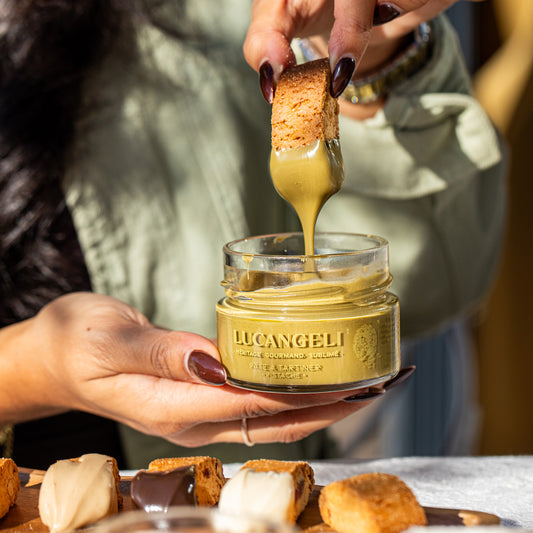
In Sicily, amaretti are made with local almonds, often from the orchards of the Agrigento or Noto region. Their texture varies depending on the family: some are soft and flavored with orange blossom, others are drier and more intense. Bronte pistachios are sometimes included in their composition, giving a green and slightly salty version found in Palermo pastries. If you want to explore this aromatic profile at home, artisanal pistachio cream offers a similar working base.
How to Use Italian Amaretti in Summer Cooking
In summer, amaretti are best expressed in cold desserts and no-bake preparations. Here are the most common uses.
Crumbled over Ice Cream or Sorbet
Crumbled amaretti croccanti over a scoop of vanilla ice cream or peach sorbet add crunch and an almond note that contrasts with the cold. This is one of the simplest and most effective uses. For a richer version, add a spoonful of Piedmont hazelnut spread between the ice cream and the crumbled biscuits.
As a Verrine Base
Crushed amaretti morbidi form a perfect base for summer verrines. Place them at the bottom of a glass, cover with a light mascarpone cream or Greek yogurt, then add seasonal fruits: fresh figs, diced peaches, poached apricots. For an even more gourmet version, incorporate a spoonful of chocolate hazelnut spread into the cream.
In a Filling for Roasted Peaches
The recipe for roasted peaches stuffed with amaretti is a Piedmontese classic. Ripe yellow peaches are cored, the flesh is mixed with crumbled amaretti, bitter cocoa, and a little butter, then baked. For a no-bake version suitable for summer, replace the cooked filling with a mixture of crumbled amaretti and almond spread, placed directly on fresh peach slices.
For Restaurant Professionals
Amaretti are included in many restaurant desserts: revisited tiramisu, semifreddo, fruit entremets. For establishments wishing to explore artisanal Italian products on their menu, the professionals' area allows them to discover formats suitable for catering, particularly nut purees in 1 kg format.
Frequently Asked Questions
What is the difference between amaretti morbidi and amaretti croccanti?
Amaretti morbidi are soft and melt-in-your-mouth, made with a high proportion of sweet almonds and little sugar. Amaretti croccanti are dry and crunchy, with some bitter almonds that give them their intense character. The two store differently and are used in distinct preparations.
How to use amaretti in a summer dessert?
Amaretti are used crumbled over ice cream or sorbet, as a verrine base with seasonal fruits, or incorporated into a filling for roasted peaches. Morbidi are better suited for fresh preparations, croccanti for crunchy bases.
Can you make homemade amaretti without bitter almonds?
Yes. A 100% sweet almond version yields a softer and less bitter biscuit, similar to amaretti morbidi. 100% almond puree – with no added sugar or additives – is the closest basic ingredient to what Italian artisans use. To explore other flavors, the set of five artisanal spreads allows you to vary the aromatic profiles.




 lucangeli.it