

In Sicily, almond trees bloom at the end of winter and their fruits ripen in the heart of summer. Cultivated for millennia on the volcanic soils of the south of the island, Sicilian almonds are one of the most iconic dried fruits in Italian cuisine. Sweet, slightly sugary, with a rare aromatic delicacy, they are distinctly different from almonds produced elsewhere in Europe. Here's everything you need to know about their origins, varieties, and culinary uses.
Sicilian Almonds: A Millennia-Old History
Distant Origins, An Adopted Land
The almond tree originates from Central Asia, but it found its ideal terroir in the Mediterranean. The Arabs, who occupied Sicily from the 9th to the 11th century, played a decisive role in the introduction and dissemination of almond cultivation on the island. They passed on to Sicilians not only cultivation techniques, but also the first almond-based recipes — marzipan, plant-based milks, confections — which have remained at the heart of local gastronomy to this day. The artisanal almond spread found in delicatessens is a direct continuation of this long tradition.
A Unique Terroir: Volcanic Soil and Sicilian Sun
What distinguishes Sicilian almonds from other European almonds is, above all, their terroir. The volcanic soils of the south of the island, enriched by centuries of geological activity, give the almonds a particular minerality and sweetness. The Mediterranean climate — hot, dry summers and mild winters — favors a slow and complete ripening of the fruit, which thus develops a superior aromatic concentration. It is this quality of terroir that justifies the use of Sicilian almonds in the best artisanal 100% almond purées, where the purity of the fruit must speak for itself.

The Harvest: A Key Moment of the Sicilian Summer
The almond harvest in Sicily takes place between July and September, depending on the varieties and the altitude of the orchards. It is a major event in the Sicilian agricultural calendar, often associated with large family meals in summer — especially around the Assumption on August 15th, a traditional holiday throughout Southern Italy. Freshly harvested almonds are first sun-dried before being shelled and sorted. This natural drying step is essential to preserve the aromatic quality of the fruit. To discover other treasures of Italian terroir to share with family, the customizable gift box allows you to bring together a selection of artisanal products around a single table.
The Main Varieties of Sicilian Almonds
Pizzuta d'Avola: The Queen of Sicilian Almonds
Pizzuta d'Avola is undoubtedly the best-known and most sought-after variety of Sicilian almond. Its name comes from the Sicilian word pizzutu, meaning "pointed" — referring to its characteristic and immediately recognizable oval and elongated shape. Its shell is smooth and hard, and the fruit inside has a distinctive coppery color. Its taste is sweet, slightly sugary, with a firm and crunchy texture. Pizzuta d'Avola is the preferred variety for Italian confectioners and pastry chefs, particularly for making confetti (sugar-coated almonds), amaretti, and marzipan. It is also excellent eaten plain, as an accompaniment to an aperitif with a sun-dried tomato tapenade and a drizzle of organic ripe fruity olive oil.
Romana and Fascionello: Two Complementary Varieties
Romana (or Corrente d'Avola) is a variety with a triangular and irregular shape, sometimes with two almonds in the same shell. Its taste is more neutral than that of Pizzuta, making it an ideal base for preparations where the almond should blend with other flavors. Fascionello, on the other hand, is distinguished by its more delicate taste and softer texture. These two varieties are mainly used in industrial and artisanal pastry, particularly for making nougat, almond granita, and almond milk. To explore the different expressions of Italian nuts, the set of 5 spreads allows you to compare almond, pistachio, hazelnut, and cocoa in a single box.
How to Recognize a Quality Sicilian Almond?
Given the diversity of almonds available on the market, a few criteria help identify a quality Sicilian almond. The shape is the first indicator: an authentic Pizzuta d'Avola is always elongated and pointed, never round. The skin color should be golden to coppery, without stains or mold. The aroma should be sweet and slightly milky, without excessive bitterness. Finally, geographical origin is a guarantee of quality: almonds cultivated in the Avola region, in the province of Syracuse, benefit from European recognition. For lovers of pistachio spread or hazelnut spread, the same level of expectation applies: the quality of the starting nut entirely determines the quality of the finished product.
Uses of Sicilian Almonds in Italian Cuisine
In Pastry and Confectionery: A Centuries-Old Tradition
Sicilian almonds have been at the heart of Sicilian pastry for centuries. Amaretti — these small, soft biscuits made from ground almonds, sugar, and egg whites — are one of the most emblematic preparations. Pasta reale (royal marzipan), colored and shaped like fruit, is a specialty of Sicilian convents dating back to the Middle Ages. Granita alle mandorle, a frozen drink made from almond milk, is a must-have in Sicilian bars in summer. These preparations all rely on the same base: quality almonds, finely ground to obtain a smooth and aromatic 100% almond purée.

In Savory Cuisine: Less Known but Equally Delicious Uses
Sicilian almonds are not reserved for sweet preparations. In traditional Sicilian cuisine, they are an ingredient in many savory dishes. Pesto di mandorle — a sauce made from almonds, garlic, tomatoes, and olive oil — is an alternative to Genoese pesto, typical of the Trapani region. Toasted and crushed almonds are used to garnish summer salads, fish dishes, or roasted vegetables. They add crunch and a sweet note that balances more intense flavors. A drizzle of organic ripe fruity olive oil on a salad of toasted almonds, tomatoes, and fresh basil: a simple and refined summer starter, directly inspired by Southern Italian cuisine.
Almond Spread: An Artisanal Delicacy
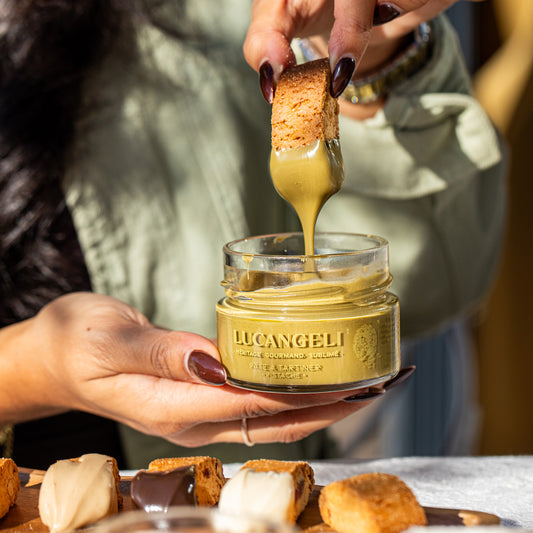
Almond spread is one of the most accessible ways to discover the aromatic richness of Sicilian almonds daily. Unlike industrial spreads, an artisanal spread made from organic Sicilian almonds contains no palm oil or artificial flavors: only the quality of the nut matters. It can be enjoyed on toast for breakfast, incorporated into homemade pastry recipes, or simply eaten with a spoon for the most gourmet. For catering or hospitality professionals wishing to offer exceptional Italian products to their customers, the professionals page allows you to discover offers adapted to establishments.




 lucangeli.it