

Italian carnival echoes with a thousand flavors, where each region unveils its culinary treasures in a ballet of golden fried delights. From crispy chiacchiere to soft castagnole, discover how the ancient art of frying reveals all its nobility when it meets the most authentic traditions of the peninsula.
In the cobbled streets of Naples as in the Venetian squares, February is dressed in sweet perfumes and gourmet aromas. The Italian carnival is not just about masks and costumes: it celebrates a millennial culinary heritage where frying becomes an art, and olive oil, a brilliant accomplice.
The art of frying: a tradition that spans centuries

Frying in Italy is not just a culinary technique, it is a philosophy passed down from generation to generation. Each nonna has her secrets, her precise gestures, her unique way of making the dough dance in hot oil.
The choice of oil: foundation of excellence
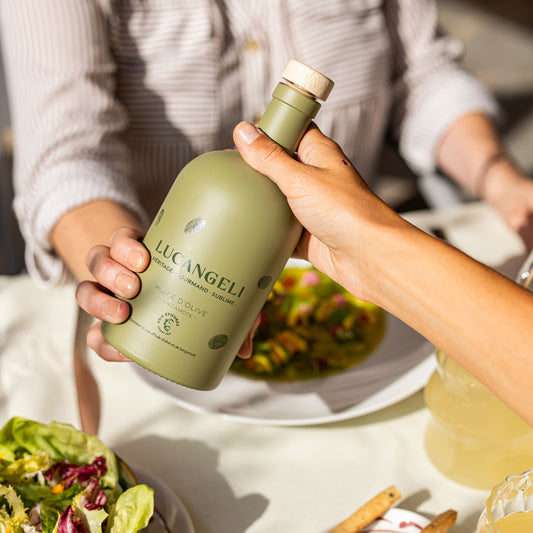
It all starts with the choice of oil. In Calabria, land of our centennial olive trees, families have always favored organic ripe fruity olive oil for its sweet notes that do not interfere with the delicate flavors of the doughnuts. This enveloping oil allows for even frying while preserving the delicacy of the preparations.
The art lies in the temperature: exactly 170°C, no more, no less. At this precise heat, olive oil reveals all its nobility, creating that golden crust so characteristic of Italian carnival desserts.
Ancient preparation gestures
Each region has its rituals. In Veneto, fritole are prepared with infinite patience, letting the dough rise slowly near the fireplace. In Sicily, cannoli are shaped around bamboo tubes, a technique inherited from the Arabs. These gestures, repeated for centuries, make each doughnut an ephemeral work of art.
The dough itself tells a story: soft wheat flour, free-range eggs, fresh butter and sometimes a hint of organic green fruity olive oil to bring that characteristic herbaceous note of the South.
The sweet treasures of the Italian carnival

Each region of Italy has developed its own carnival specialties, creating a mosaic of flavors that reflects the cultural richness of the peninsula.
Chiacchiere: golden lace from the South
Originally from Naples, chiacchiere - literally "chatter" - are well named. These thin strips of fried dough, light as feathers, crackle under the tooth, releasing their aromas of lemon and vanilla. Their secret? A dough worked for a long time, rolled thinly and fried in first quality olive oil.
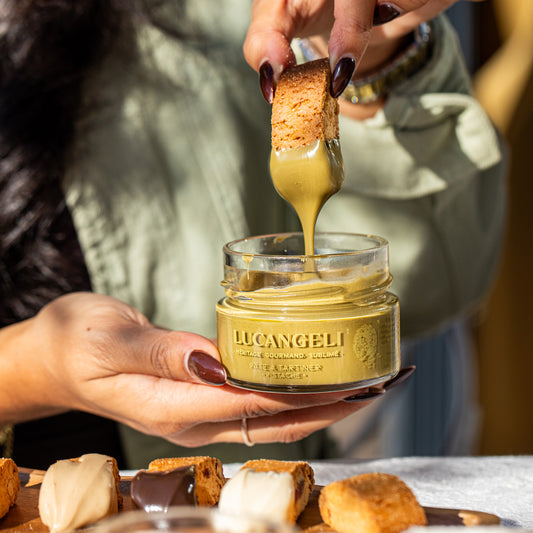
In Calabria, they are traditionally accompanied by an artisanal hazelnut spread, creating a striking contrast between crispy and creamy.
Castagnole: soft pearls of the carnival
These small golden balls, whose name evokes chestnuts, embody Italian gourmandise in all its simplicity. Soft inside, crispy outside, they vary by region: with ricotta in Campania, flavored with anise in Umbria, or enriched with a pistachio spread in Sicily.
Venetian fritole: jewels of the Serenissima
Venice gave birth to fritole, these generous doughnuts filled with raisins and pine nuts. Their dough, enriched with grappa and flavored with lemon zest, requires particularly delicate frying. Olive oil, heated with precision, allows to obtain this particular texture, both airy and melting.
Perpetuating traditions in modernity
Today, culinary traditions are evolving while preserving their essence. New generations are rediscovering these ancestral recipes, sometimes adding their personal touch.
Respectful innovation
Some contemporary pastry chefs revisit the classics: dark chocolate chiacchiere, castagnole filled with bergamot cream, or even fritole with exotic fruits. The essential remains: the quality of the ingredients and the respect for traditional techniques.
A gift box composed of exceptional olive oils and artisanal spreads now allows to recreate the authenticity of these moments of sharing at home.
Transmission of know-how
In Italian families, February remains the month of transmission. Grandmothers teach their grandchildren the art of frying, teach them to recognize the good sound of the dough plunging into the oil, to feel when the temperature is perfect.
Carnival, mirror of the Italian soul
These culinary traditions reveal the deep soul of Italy: generous, creative, attached to its roots but open to the world. Each doughnut tells a story, each recipe carries within it the memory of a territory and its inhabitants.
The Italian carnival reminds us that gastronomy is not just about technique, but about emotion and sharing. In every kitchen where laughter echoes and warm olive oil embalms, a millennial art of living is perpetuated, that of authentic dolce vita.
Thus, when Mardi Gras comes, all of Italy transforms into a huge open-air kitchen, where traditions and modernity mingle, in a gourmet ballet that celebrates life and conviviality. For beyond the masks and disguises, it is around the table that the true magic of the Italian carnival is revealed.





 lucangeli.it